

Car trouble on Shab-wah-sung Boulevard in 1922. – Courtesy of Omena Historical Society
What becomes of an Omena tradition when a main road changes it’s path?

The original boardwalk and Shab-wah-sung Boulevard on Omena Point. – Courtesy Omena Historical Society
The old Shab-wah-sung road is that road. It once ran around Omena Point on the shore, having been built for horse and buggy traffic. The shore road ran from the village of Omena all the way around the end of the Point to the Ray cottage where it diverted into the woods. In the early days it was used for deliveries, and for bringing people to the hotels from the steamers which brought them to Omena.
People from the hotels strolled along the adjacent boardwalk exchanging polite waves or a word or two. Cottagers used the boardwalk to go visit their neighbors and to town, enjoying the flower beds and cement benches along the way. The boardwalk alongside the road was laid in 1900 by Wilder Graves with the help of his faithful horse, Fred.
Who was this Wilder Graves who took on this huge project?
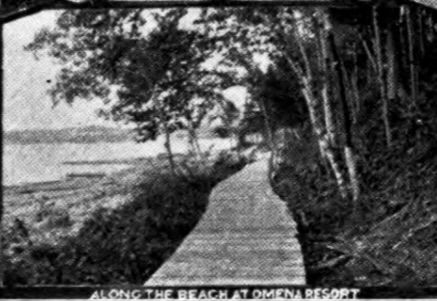
A photo of the original boardwalk from about 1900 – Courtesy Omena Historical Society
Wilder Graves lived in a small, rustic, log cabin he built himself on the Point in the mid 1890s. While a simple structure, it was it’s Victorian flourishes that made it exceptional. On the porch which was made of rough logs he had created decorative railings and roof flourishes from branches. On top of the gabled ridgeline, he added a decorative metal roof cresting in the Victorian style of the time. From the outside it resembled a Queen Anne log cabin. He had the ambition, imagination, and skill to build a walkway along the shore road.
The walkway existed as a simple board walk until 1910. It was big news when it was made into a cement sidewalk. A 1910 newspaper article reports: “The most conspicuous achievement is the long span of cement walk along the beach partly replacing the famous board walk laid by Wilder Graves and his faithful horse Fred, a decade ago.”
In Need of Repair
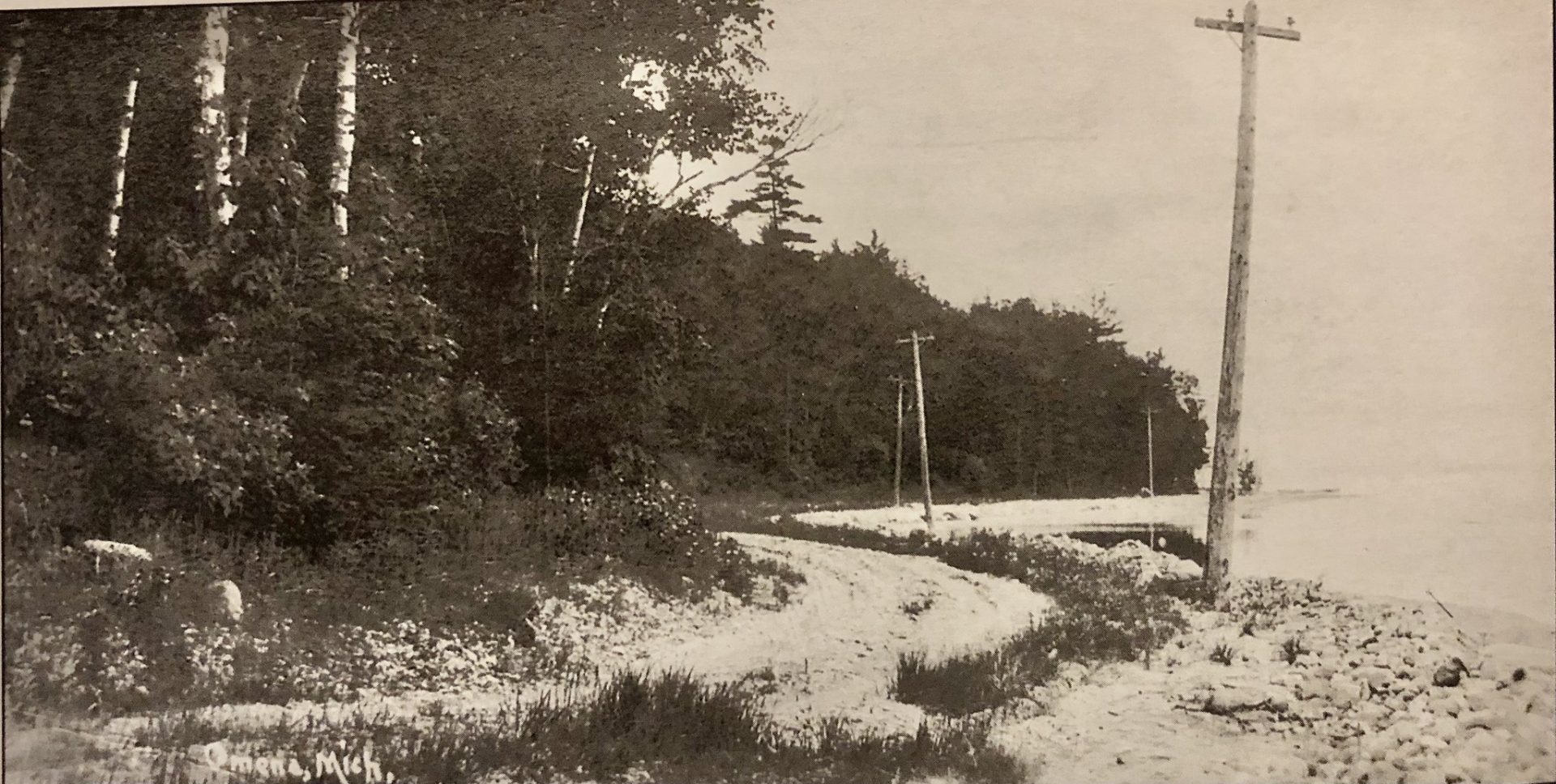
Electric poles ran beside the shore road and were sometimes also the victims of water damage. – Courtesy Omena Historical Society
However, the old road along the shore was in a bad place both because of the constant dust being kicked up from passing vehicles, and because it needed repair often, especially in spring, from damage caused by the changing water levels and wave action of Grand Traverse Bay. Large sections of the road washed out repeatedly. Between 1914 and 1918 and entire section of road washed out in front of Schram and Bauer’s property and the Pavilion, the present day Yacht Club. An electric light pole washed out as well. Repairing the road to make it usable was the responsibility of the cottagers. They piled rocks along the shore side of the road but that did little to prevent damage. It was a huge job keeping the road usable.
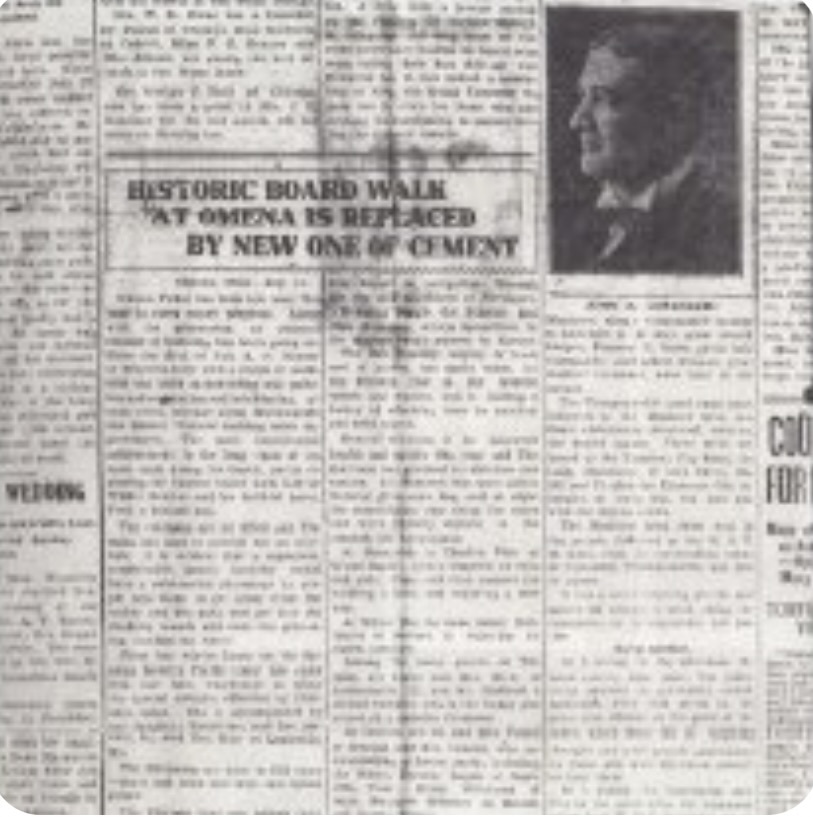
The newspaper announcement of the replacement of the Omena boardwalk with a new cement one. – Courtesy Leelanau Historical Society
Repairing the road highlighted the tensions cottagers on Omena Point created by the automobile. “The Cottagers who own and use automobiles,” Rebecca Richmond wrote to Santo, who was heading up the effort to improve the shore road, ”should contribute to the Road Improvement to a greater extent than those who do not.” Some agreed, but a growing number of automobile owners did not apparently. The disputes surrounding the old shore road eventually led to its abandonment. By 1935 a new road cut through the woods away from the water.
Vacate the Shore Road?
It is not clear exactly who spearheaded the effort to vacate the shore road, and build a new road around Omena Point but probably it was led by Hector Carmichael, who “fathered and nursed along” the idea. Although he had the best interests of the community in mind, he also would gain by a better road. Charmichael was the owner of the Oaks and seven cottages as well as considerable property away from the shore, which would benefit from an improved road access. He also made sure that the county would be responsible for the upkeep of the road rather than the people who had cottages on the Point who had struggled with the constant maintenance of the shore road. He probably arranged for Works Progress Administration (WPA) to construct at least a part of the new road as well.
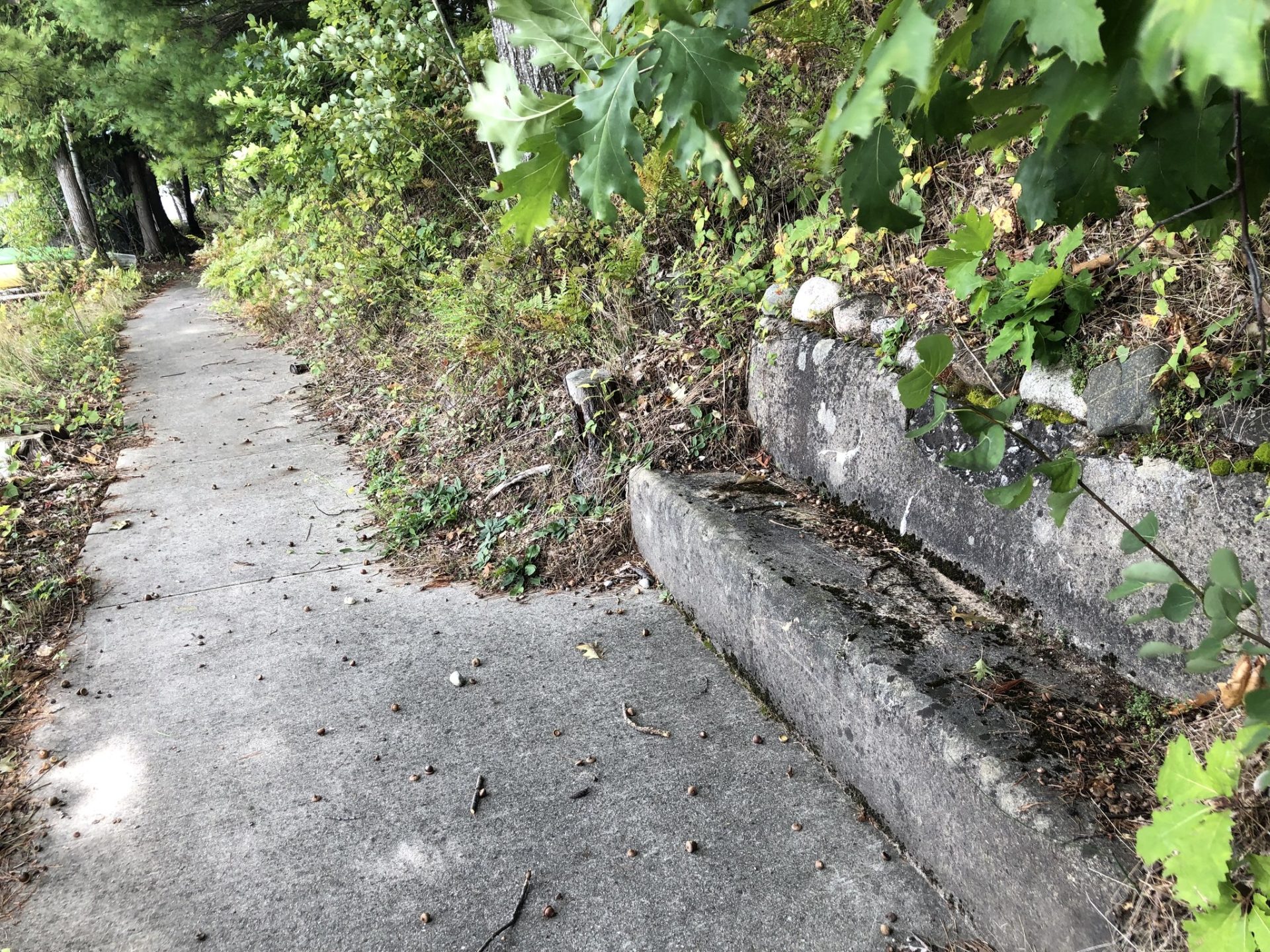
One of several old cement benches that are still along the sidewalk today. –
Photo Courtesy Lynn Spitznagel
But what was to become of the sidewalk alongside the shore road? When the new road opened around the Point and diverted traffic away from the shore, the old road and the sidewalk fell victim of the rising and falling water levels, and the road gradually disappeared. The sidewalk suffered as well. Parts of it were swept into the bay with storms and high water. Would there be no more using the sidewalk to visit neighbors, or just to go out for a walk in the evening enjoying the water and the neighbor’s flower beds? For a time, the sidewalk survived only here and there, with tilted sections and overgrown sections preventing walking on it.
Cottage Owners keep the tradition alive
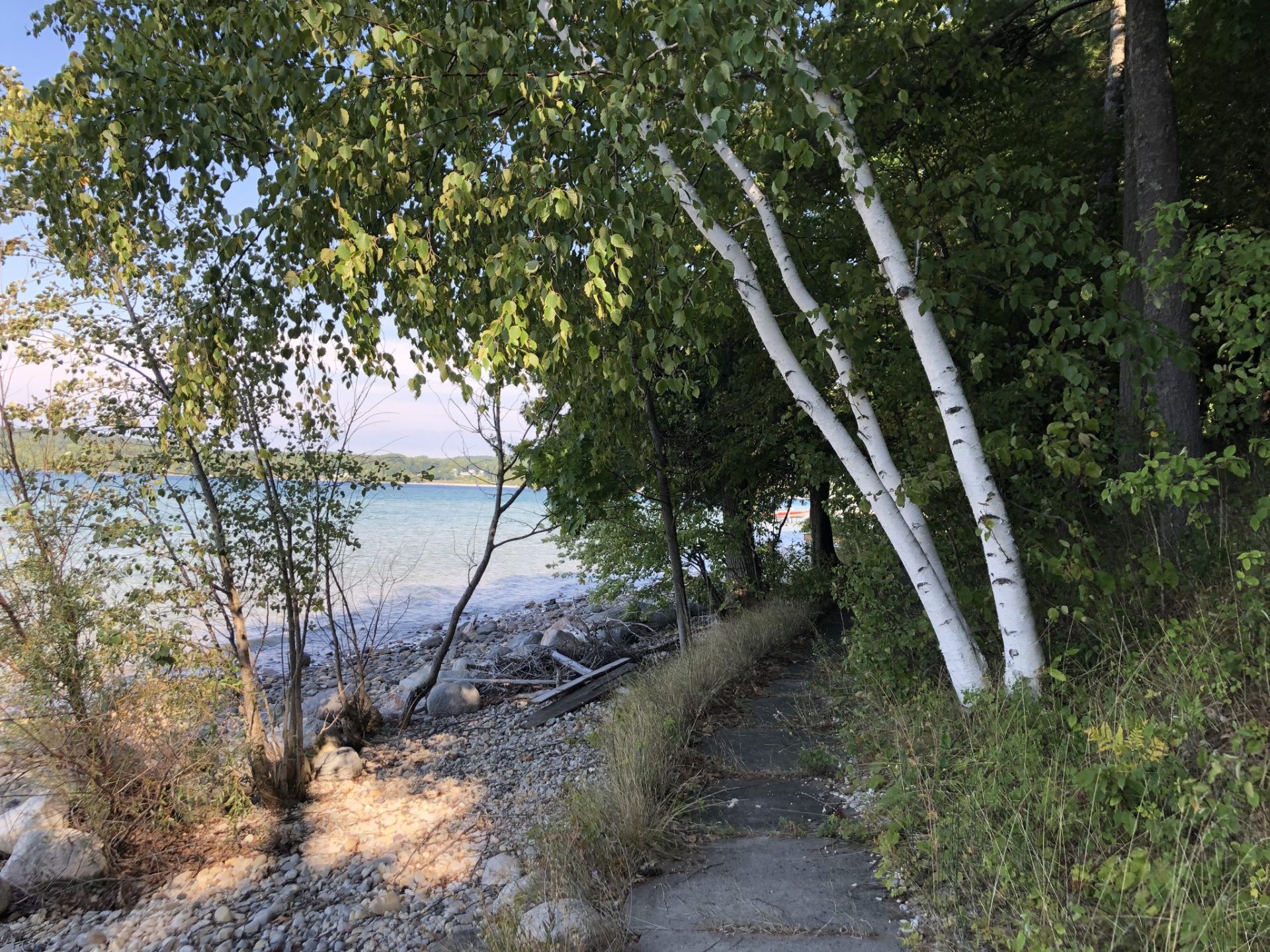
A recent photo of the old sidewalk with the village visible across the bay. – Photo courtesy Lynn Spitznagel
Then, one by one, adjacent cottage owners began making improvements to the old sidewalk. Some replaced all the sidewalk in front of their homes. One built little arched bridges over the tilted sections. Where the high water undercut the old sidewalk, homeowners shored them up again or replaced them. One homeowner has had workers working on the construction of their new home break up the old sidewalk, making it impassable. Several neighbors, wanting to keep the neighborly tradition alive, asked them if they planned to replace the sidewalk. “Of course” they said. Shortly afterward, they smoothed out the rubble so walkers could still use it until they replaced it with new.
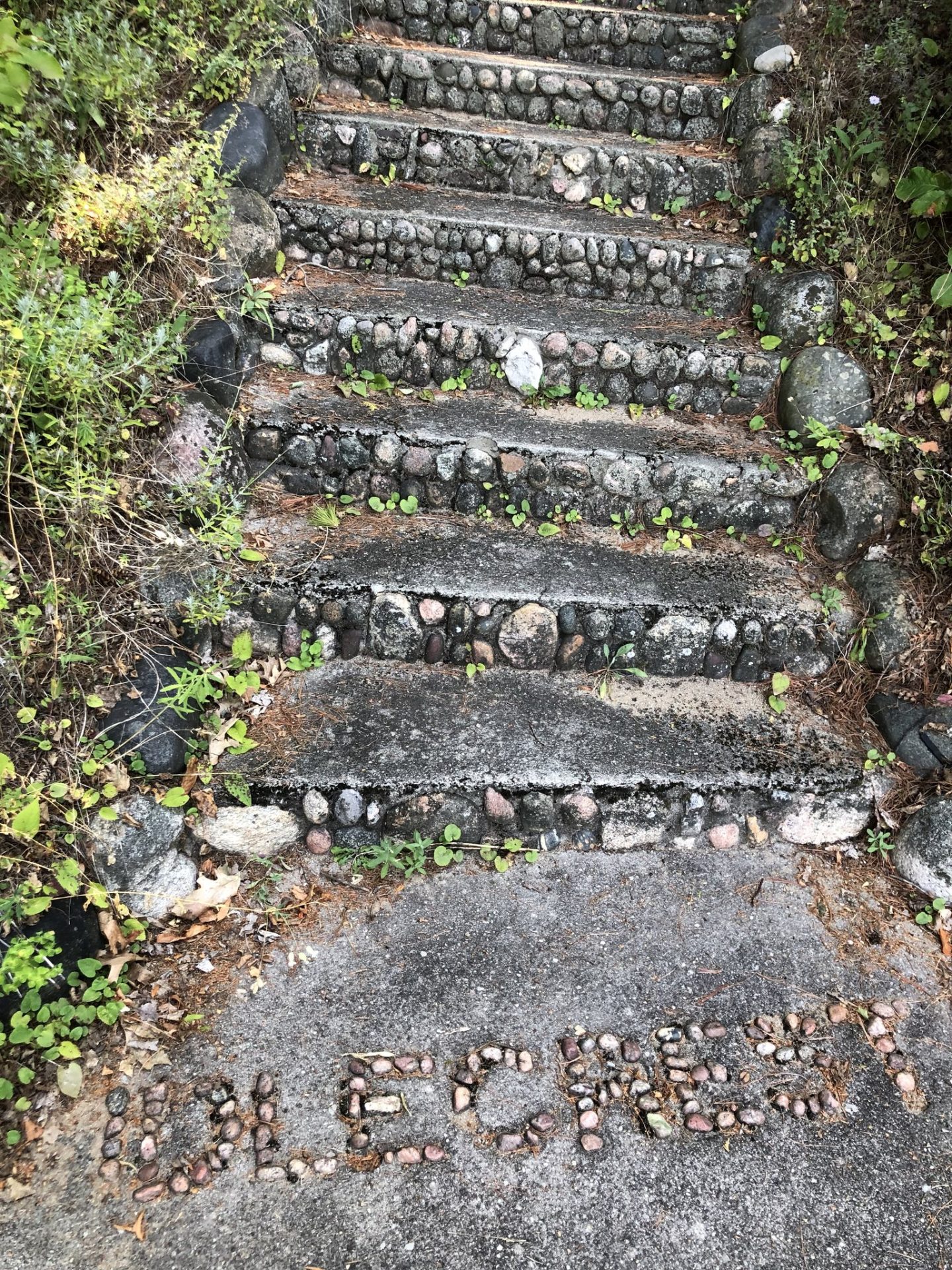
“Idlecrest”, the historic name of this cottage, spelled out in stones. – Photo Courtesy Lynn Spitznagel
Two homeowners brought in sand where the sidewalk once stood, but are not against the tradition of “sidewalk walking” which persists today allowing neighbors to cross the sand to rejoin the sidewalk on the other side. Only on two low beaches has the sidewalk been washed out completely and the beach is too low to rebuild it. The low beach is crossable so that even now walking from the yacht club to the end of the point is possible. The old cement benches remain, and some cottages still have their cottage names spelled out in stone at the bottom of the steps up to their cottages as they have been for generations. It is a treasured Omena tradition that has continued thanks to the cottagers of Omena.
Courtesy “Omena, A Place In Time” by Amanda. Holmes, and The Omena Historical Society

The sidewalk today near the end of the point. – Courtesy Lynn Spitznagel