The coming of cars in the 1920s changed life in Omena for the old and the young. For the locals who made deliveries of ice and food, and the summer people who wanted their independence from train and boat travel. The passenger and steamers, as well as the smaller tourist vessels, gradually disappeared. Scheduled train service diminished too, as people grew to prefer the freedom that automobiles provided.

Car trouble on Shab-wah-sung Boulevard in 1922. – Courtesy of Omena Historical Society
Kids could get a drivers license when they were fourteen in Michigan. Driving provided a chance to expand their horizons for teens eager to leave the confines of their cottages and families. When Ruth Freeland was a teen, she named her old car Pandora. No doubt because she never knew what would come out of an adventure in it. Her friend Cecile named her car, an old scratched up Ford, Mercedes. It was, Cecile believed, “perhaps the oldest Ford in Leelanau County”.
Boys took old cars and made them work again. Schram and Bauer, the fishermen, had an old 1902 International truck parked in back of their place. It had been rotting away for at least twenty years. A young Waldo Abbot and his friends asked if they could have it. The fishermen said “Sure”. They pushed it home and in no time they had it running again. “It would go eight or ten miles an hour!” Waldo said. He took all the kids on the Point for rides to Sutton’s Bay and to Northport.
Tinker with cars
Often adults had less luck when they tinkered with their cars. Archie Clark “repaired” his red sport touring Marmon until it was just a pile of parts. When they drove the Marmon up from Indianapolis for the summer it had worked, but Archie wanted to tinker with it. Archie spread all the parts out on a blanket in the front yard in front of the porch steps (making it impossible to reach the steps from the road). There was, they say, some friction around the cottage. Some days it could be heard several cottages away. July went by, then part of August, and Archie could not get the pieces back together. Archie covered the parts to keep sand out of them, and sought help from the local auto repair man. The Con Lather Ford Garage in Sutton’s Bay, which could no doubt have fixed it, absolutely refused to travel up north to Omena to try to put the Marmon back together again. Archie sought help from the Marmon factory in Indianapolis. He was able to convince them to make the trip up to get the car running again, returning peace to the cottage.
Driver’s Ed?
Learning to drive wasn’t easy for older drivers either. Ruth Freeland Carmondy in her book “Omena, Oh, Is That So” writes about Mr. Anderson trying to master the techniques of driving his Ford. His married daughter drove him when he needed a ride, but one day it was necessary to take two cars to Traverse City, so she drove hers and her father followed in his Ford. She watched him through her rear view mirror but the road was hilly and crooked and crossed the railroad tracks “every chance it could.” The train was not large, fast nor prompt, but it did come along twice a day. Mr. Anderson’s daughter crossed one of the tracks and saw the train coming. There was plenty of time, she thought, for her father to cross also. But when she looked in the mirror she realized that the train must have hit her father’s car. She rushed back in time to see the train men pulling her father from his wrecked car, undisturbed and unhurt. “As he slowly rearranged his badly wrinkled clothing , he calmly commented, ‘Well, that was mighty sudden.”

Anderson’s store with 2 gas pumps
Alcohol and driving
And then there was alcohol, which didn’t mix well with driving but sometimes did produce amusing results. Big Joe had been celebrating in the town bar, and started home in his car. He noticed one of his neighbors , Dave, walking home, so he stopped to pick him up. At one of the many railroad crossings Big Joe missed the turn and went on down the railroad tracks instead. The headlights were a bit dim, and so were Dave and Big Joe after all their celebrating. The road was rough, but the railroad track was even more rough so finally Dave suggested, “Big Joe, I think you are driving down the railroad track.” “I believe you’re right,” Big Joe answered and turned around, heading back to the road. When Dave got home he told his wife he didn’t think Big Joe could see so well anymore and he didn’t think he would ride with him again.
Sometimes older drivers who were careless about cars met with tragic ends. On September 18th, 1923, the well respected Chief of Police of Traverse City, John Rennie, attempted to start his car while it was still in gear. The crank threw him to the pavement and he struck his head with such force that he died on the way to the hospital. He was 71 years old.
Courtesy ‘Omena, Oh Is That So’ by Ruth Freeland Carmondy; ‘Omena, A Place In Time’, OHS; and Grand Traverse Legends, by Robert E. Wilson
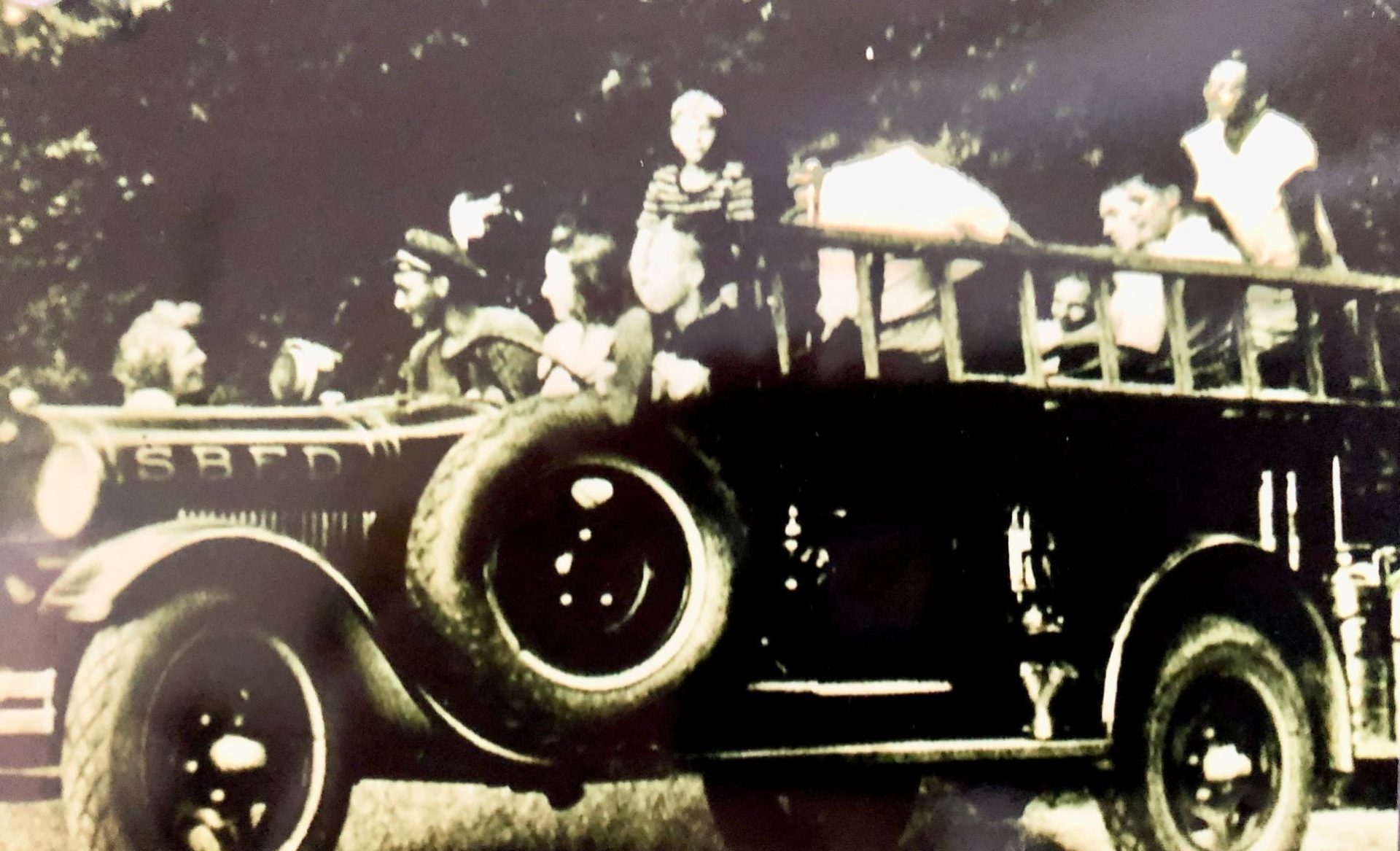
Omena kids racing around the Point in the “stolen” Sutton’s Bay Firetruck. Originally given permission if they followed the rules, no speeding and no siren until they passed the church (although the cranking began enthusiastically about two feet past the church), As they were in the midst of eating ice cream Sundays afterward at the Ice Cream Parlor, a police car roared up, sirens screaming. The mayor and deputy stepped out and announced the arrest of Jack Stevenson and Jim Centner, who had borrowed the fire engine. After spending a few hours in jail, the charges were dropped. There was an election coming up and the mayor was up for reelection. Some residents of Sutton’s Bay were giving the mayor much grief over letting the “resorter kids play with the fire engine.” Jack and Jim went on to college in the fall as free men. – Courtesy Omena Historical Society