
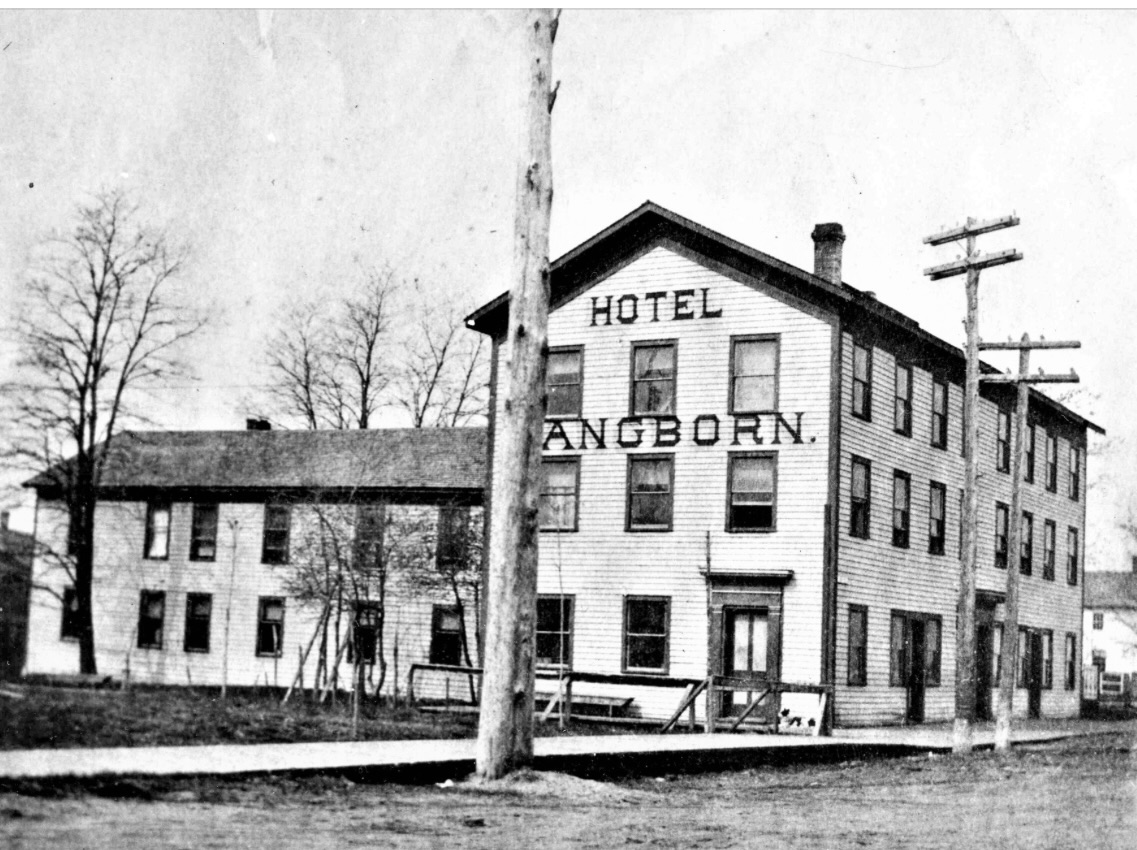
Originally the Hannah, Lay & Company Boarding House, this building was on the SW corner of N. Union and Bay Street. At that time, Dr. Goodale was running it and his 15-year-old daughter, Helen Goodale, was Traverse City’s first schoolteacher (if you do not count the schooner school). This is where Helen lived during that time. – Courtesy Traverse Area District Library.
I had thought 15-year-old Helen Goodale, (the daughter of Dr Goodale who delivered the mail from his big pockets) was the schoolmarm in the first non-Indian school the area, but I was wrong. Her little log school, with the snakes coming up through the holes between the floorboards, started in 1853, but two years earlier another school started up, with a very select group of students.
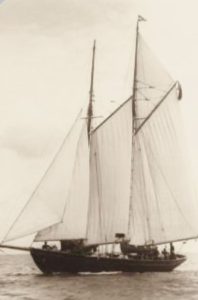
A rare early photographic print of the Schooner Cacounatack in the Solent. They were able to research the history of the original Madeline and other such watercrafts, though the actual plans for it, or photos, were never found. This is a similar schooner. – Courtesy The Leelanau Ticker.
The Schooner Madeline
Five young men arrived at Old Mission in November of 1851 intending to winter over there. They were sailors aboard the Schooner “Madeline.” Three of them were brothers named Fitzgerald, and one was the captain. A fourth was named William Bryce, and the fifth was the cook, no name recorded. They were good sailors, but they could not read, they were not even “tolerable readers. One could not even sign his name, they knew they needed some book learning to become successful.
They chose this spot because in this wilderness there would be few distractions. Probably were unwilling to go to a public school in a port city where their lack of education compared to younger students would be an embarrassment. But right away they had a problem, the man who they had engaged for their teacher did not show up.
Luckily, they were able to hire a seventeen-year-old boy, S. E. Wait. He was hired to teach them reading, writing and arithmetic for twenty dollars a month plus board. Bryce and Fitzgerald’s were to pay him, and the cook would provide their teacher meals for his schooling. The “Madeline” was secured and carefully anchored for the winter at Bowers Harbor.
Schooner School
“The after-hold was converted into a kitchen and dining room, and the cabin was used as a school room. Regular hours of study were observed, and the men voluntarily submitting to strict school discipline. Out of school hours they cut firewood and brought it on board and did other chores. Sometimes there was time for snowball fights, which they sometimes engaged in with the delight of genuine schoolboys. The bay that year did not freeze over till March. Previous to the freezing, the wood was brought on board in the yawl. Afterwards, it was conveyed over the ice. Except going to Old Mission occasionally, the party was entirely cut off from communication with the outside world.” read one description of the Schooner School.
The school must have been a success for all the young men went on to successful careers on the Great Lakes. One of Captain Fitzgerald’s grandchildren headed an insurance company. The insurance company owned and named another famous boat, The SS Edmund Fitzgerald.
Traverse City First Schoolhouse
And then the next year, 1853, 15-year-old Helen Goodale was hired to teach in the first schoolhouse in Traverse City. There was not an organized school board yet, but private donors paid her $1 a week and room and board in the Hannah, Lay & Co Boarding House. The school was a log building that had been thrown together for use as a stable located in a wooded undeveloped area. Here is how Helen later described it – “It was nothing but a chinked crib, constructed with logs cut with an ax of unequal lengths. The roof boards were of all dimensions, nailed to a sagging ridgepole regardless of projections. There it stood in a clearing, ready for the children.”
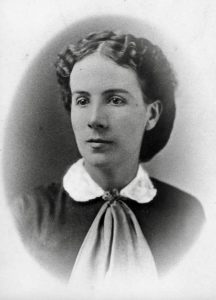
In 1853, 15-year-old Helen Goodale was hired to teach in the first schoolhouse in Traverse City. – Courtesy Traverse Area Historical Society Local History Collection
Inside there was a long continuous desk around two sides built right into the wall. The desk was supported by square sticks which slanted from the desk to the wall. Two long benches served as the seats and there were but a couple of chairs. A stove stood in the middle of the room, keeping some of the cold away. Textbooks were gathered from wherever they could be found. Some came from Canada, some from Vermont, or New York. Some came from Wisconsin and even from Beaver Island.
Is this really a school?
Miss Goodale was reportedly very happy with her rustic schoolhouse. And her students were happy with her. The first summer she had 12 students. Over the winter when school was not in session, she studied in Chicago coming back the following summer to a classroom of 20 students….and a fifty-cent raise. She taught six full hours a day, five days a week, all ages. Here is how she described her students: “My scholars were eight nice, neat girls, and twelve sturdy boys; happy, and interested children. Some of them delighted with the novelty of the school in the woods, others with the privilege of a school in their new home. Some could not resist the impulse to suddenly jump up and exclaim ‘Is this really a school?”
Hats off to teachers then and now in this last full month of the school year. As the weather gets nicer, and children’s attention is harder to keep, a teacher’s job requires lots of patience and perseverance!