
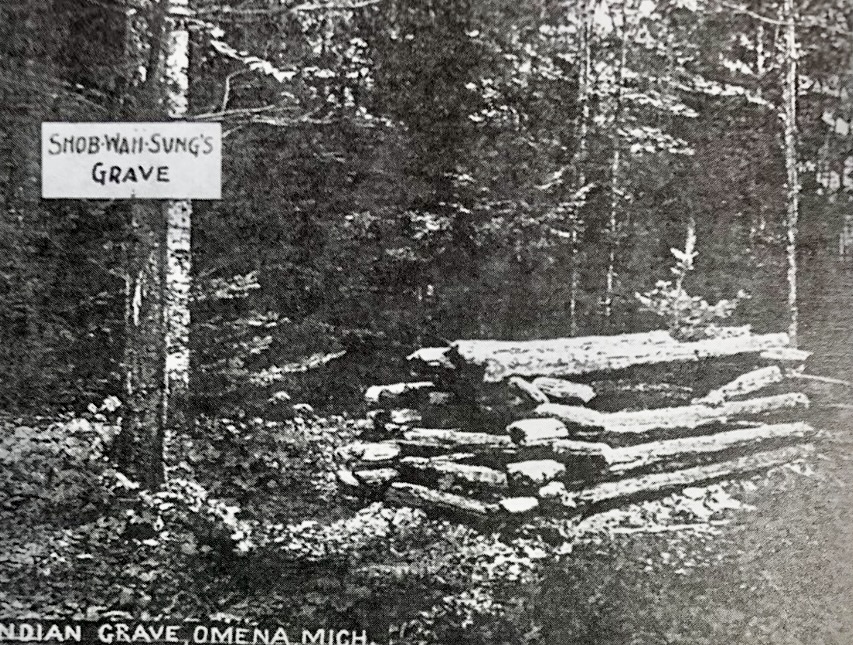
Local hotel owners created mythical sites for their guests to explore, like Shob-Wah-Sung’s Grave, which drew on the area’s Indian heritage (ca. 1905). – Courtesy of the Omena Historical Society
There was once an old Indian Chief, who had a “pipe of peace” that he highly prized. This Peace Pipe, or Calumet, was something to behold. The stem was flat and over three feet long. It was engraved on both sides with strange Indian characters, each character of which had a meaning.

Chief Wakazoo of Northport with his peace pipe, which looks similar to that of Chief Shabwasung. There are no known photos of Chief Shabwasung. – Courtesy of Omena Historical Society
The chief had used the pipe many times at the Indian peace councils. In fact, when the United States government negotiated treaties with the Indians for their lands, Chief Shabwasung took an active part in the Council’s deliberations. The peace pipe could very well have been there for that momentous occasion.
It had been handed down to him for seven generations. You would think he would pass it on to his son, or at least his daughter for a future grandson, when he passed. But no…. just before he died, he gave it to Aaron Page, Omena’s long time postmaster, Why would he do that? This is the story of these two men and how their lives might have intertwined.
Respected Leader
Chief Shabwasung was a very respected leader of his tribe. His manner was dignified and sedate, he seldom laughed and talked little. A man of strong will and good judgment, his word was law with his tribe. He was respected and recognized as a brave and competent leader. Perhaps he was not pleased with his 2 grown children, or perhaps they moved away, as children often do.
The chief, Page tells us, was married twice. When his first wife died, he went into mourning and his face was blackened with charcoal. He wore a certain type of shirt which gave him quite a hideous appearance. It is not surprising that he remained alone for several years before taking another wife. Perhaps he became alienated from his children at this time.

Aaron Page’s boarding house served loggers and early settlers, and was the location of the first Post Office until 1881. This photo (ca 1905) was taken just after the logging ended and tourists began to come to Omena) – courtesy Omena Historical Society
Aaron Page
Aaron Page was also an early settler, and well respected person in the area. Page first settled in Northport, and was the postmaster there for a time. There he met and soon married Amira Dame in the mid 1850’s. By 1859 he had moved to Omena and built his boarding house on the west bluff overlooking Omena Bay (opposite where Sunset Lodge is today). His boarding house served loggers and early settlers. It was the location of the first Post Office from 1859 until 1881, and during this time, Page was the postmaster. Perhaps this is when he became well acquainted with Chief Shabwasung.
At the time of his death, Shabwasung was living near Northport and was sick with consumption. Abel Page (Aaron’s son) gave this interesting account of the old chief’s death. “One day on his way from Traverse City, (then wild) with his family in a boat, he was taken worse and they camped on the Mission Point (Omena Point) where they remained until he died. By his request, he was buried there on the wave washed shore of the beautiful bay he loved so much. His bright spirit took its departure to the happy hunting grounds of the noble red man.”
Tourist Traps
Local hotel owners created mythical grave sites for their guests to explore. To this day some Indians think they know where that the chief is buried and have asked to be allowed to “lay some tobacco down” to respect the old chief. Abel Page liked the idea that nature has it’s own way of honoring Chief Shabwasung. “The wild duck from the sparkling waters of the bay came and made her cozy nest among the fallen leaves on the grave of the silent sleeper. For a number of years one of the wild ducks made its nest and raised its young on the grave of Chief Shabwasung.”
Courtesy Omena Historical Society’s archives for sharing the writings of Elizabeth Craker Armstrong, and “Omena, A Place In Time” by Amanda Holmes