
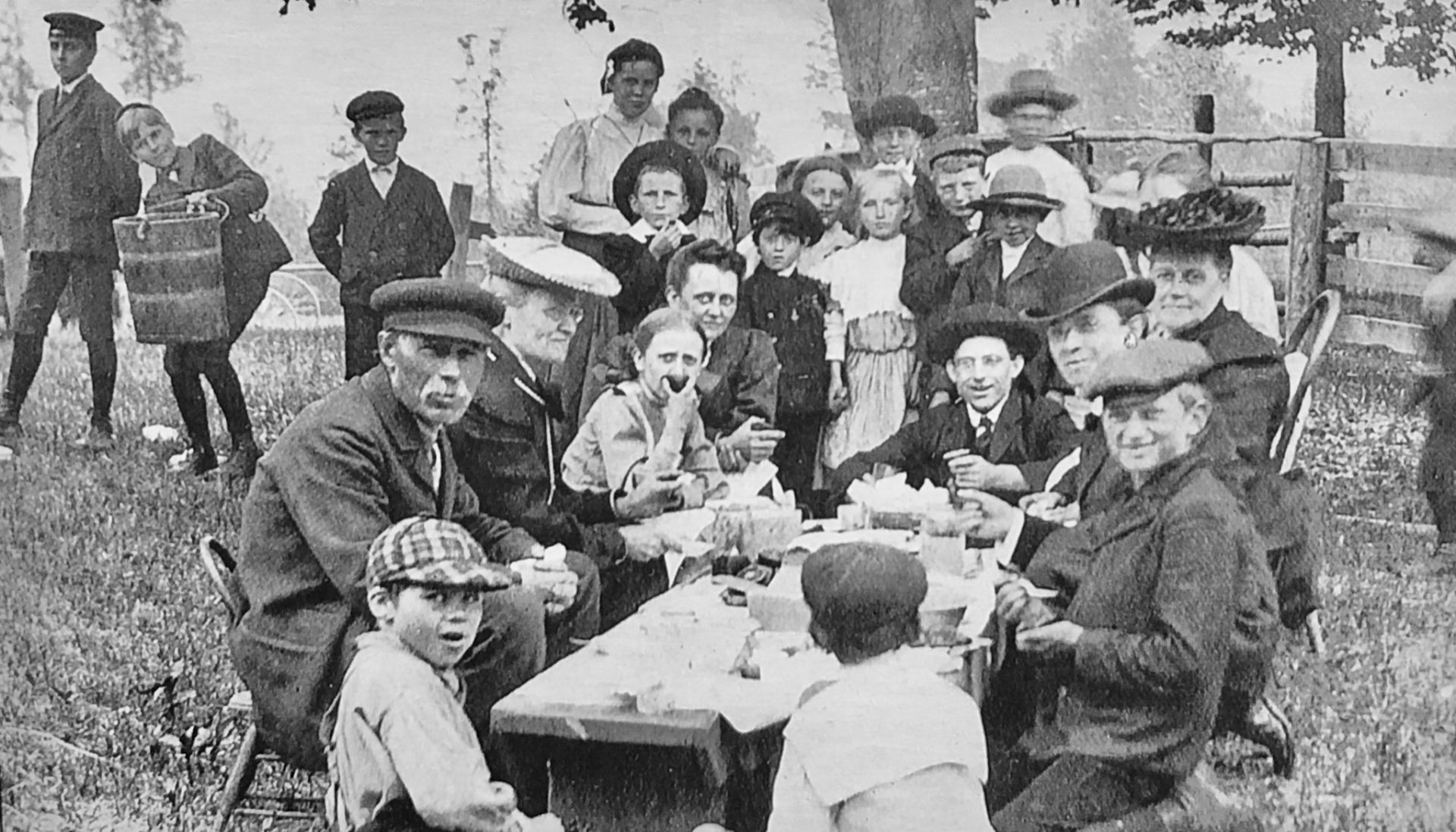
Church Picnic ca. 1900 – Courtesy “Omena, A Place in Time” by Amanda Holmes
Did the people just get up in church one Sunday morning during the sermon and storm out of the little white Presbyterian Mission Church because the sermon was boring, or too long, and then form a new church? Did they not like the preacher? Or was it just too tiresome for them to sit through the sermon twice, once in English, and then once translated into Anishinaabe (the local Indians’ language)? Why on April 18, 1886 did the people of the little hamlet of Omena decide they had to have two churches, the Presbyterian Church and the nearby Congregational Church?
Well, it is complicated. The Omena Presbyterian church was founded in 1852 and the beautiful church itself was built in 1858 with the help of The Presbyterian Board of Foreign Missions. Nine years later, the Board of Foreign Missions withdrew their support, leaving the little congregation in Omena struggling. Rev. Dougherty sold off the mission buildings up on Omena Heights the following year which allowed him to continue the ministry for a few years, but by 1871 and out of money, he had had enough and retired, leaving town shortly afterward for Wisconsin. At that time George Craker, the most prominent layman in the church, was in despair. “Peter Dougherty has left us.” he wrote. “I don’t know what to do. This church building is old. It is badly in need of paint and repair. The Indian Congregation is poor.” But George was determined to do what he could to keep the church going. Because he knew the Indian language he kept the Sunday School alive.
Rev. Dougherty Retired
There were no regular church services, but occasionally Rev. George Smith of Northport and other Congregational ministers held a service at the beautiful Omena Mission Church. Perhaps frustrated by the Presbyterian form of government and its board of Foreign Missions who withdrew its support, some were tempted by the Congregational Church polity which is ruled by the congregation with no hierarchy over the local church. And so it came to pass that in 1886 Rev. C. D. Bannister of Northport, with Reverend Puddyfoot of Traverse City acting as Scribe, officially organized a Congregational church in Omena. They had twelve charter members and no building. Services of the newly formed Congregational Church were held at the Presbyterian Mission church, along with the Presbyterian Sunday School classes and occasional services by visiting ministers.
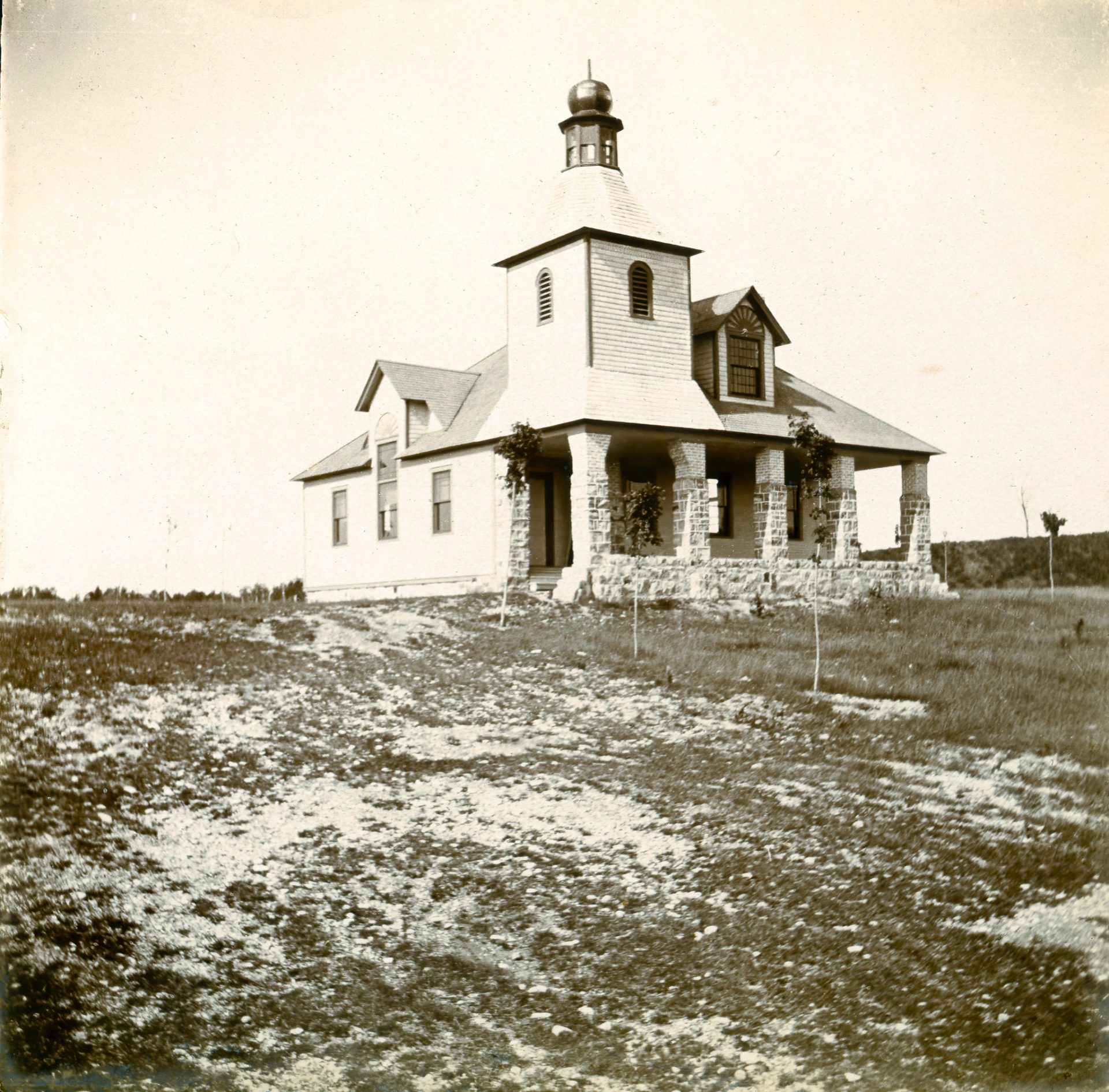
A rare early photo of Omena Congregational Church from the archives of Omena Historical Society.
A New Church is built
Then in the 1890’s the Governing Presbytery Assembly renewed their support to the Omena Mission Church and after eight years of sharing the same building, the Congregationalists separated from the Mission church and constructed their own building 1100 feet east of the Presbyterian Church in Omena. Although there are no records of how these 12 people raised the money to build a church, records of the 1901 addition mention an all-day “work bee”, subscriptions (promises of support) by the parishioners, and the Ladies Aid ice-cream socials at Sunset Lodge and annual fundraising dinners each summer. They even put on plays with a modest fee to attend.
From the first, the new Congregational Church had trouble meeting their expenses. The minister frequently could not be paid. The Ladies Aid Societies fund raisers, and the Sunday school Fund were often relied on to keep the church going. This led to frequent departures of the ministers, and attempts to reunite the church with the Presbyterian Mission Church in Omena as well as the Congregational Churches in Northport and Sutton’s Bay.
By 1901 they had grown from the original 12 charter members to 34 in 1898 and then to 56 in 1900. They seemed to be having some success with a well-liked new minister, but then they over extended themselves by building a big addition onto the church and horse sheds they couldn’t afford.
The Minister and the Drunk Parishioner
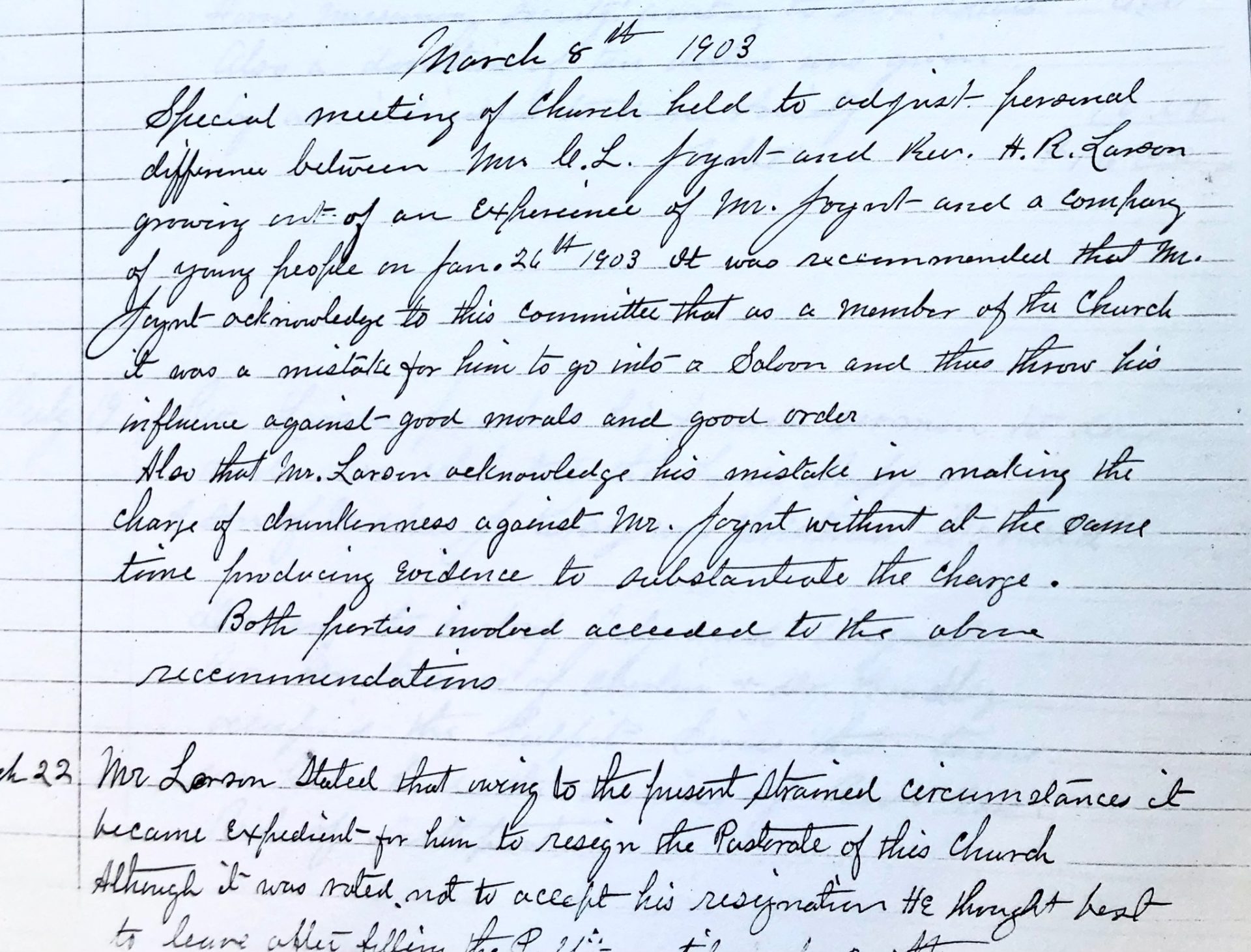
The 1903 page in the Omena Congregational church meeting minutes that describes the “personal differences” between the pastor, Rev. H. R. Larson, and one of the parishioners, Mr. C. L. Joint over drunken behavior that led to the pastor resigning. All the minutes are hand written in pen and ink. This is one of the more readable pages.
It all came crashing down when in 1903 the popular minister had a run in with one of the parishioners and quit (see photo of minutes).
In 1907, without a minister for over a year, church attendance flagged, and membership dropped. Financial problems worsened. They were able to get a regular minister, however by 1909 they were unable to pay his salary and he left.
Uniting with the Church in Suttons Bay
They needed a solution to their problems and found one that year. They united with the Congregational Church of Suttons Bay. The following years were, as written in the minutes, “the most uneventful period in the history of our church.” Only the wiring of the church for electric lights in 1914 raised some excitement.
Near the end of 1920 a meeting was held at the Congregational Church. The purpose was to “devise some plan by which the entire community might work together as one church.” They voted to become a “Federation”, uniting with the Omena Presbyterian Church once more.
Congregationalists Demands
However a few months later in the spring 1921 there was discontent among the Congregationalists. They met and decided if they were to remain a Federation with the Presbyterians, the following demands would need to be met:
1.That we have a change of pastor.
2. That there be a service for the white people held in the Congregational Church each Sunday.
3.That Sunday school classes for Indians and white people be separated.
The minister bristled at the demand that he resign, and refused to leave. He stated the Congregationalists were not “the choosers” of the minister. That he would stay out his contract to the two churches until the first of the following year.
Leaving the Federation
After that, the Congregationalists, who wanted control over their own clergy, voted to end the Federation at the end of the month. By the following month had been rededicated as a Congregational church.
By 1924, with financial problems again, they decided to not have church during the winter. The Ladies Aid was paying for the repairs to the church building. In July, there was a deficit of $272. By 1928 Annual Meeting minutes showed the treasurers report having a deficit of $300 in the ministers salary with all other debts paid. The minister immediately resigned.
Three Churches Band Together
In June of 1929 with the depression beginning, the three Congregational Churches in the area, Sutton’s Bay, Omena and Northport, joined in hiring a single minister who served all three congregations.
In March of 1930, Rev. Badder read the letter of resignation of Mr. Freeland. He resigned from his position as clerk and member of the church. Mr. Freeland stated he believed that modern transportation made it advisable to unite with either Northport or Suttons’ Bay Congregational. No doubt their financial worries played a part in his decision as well. Mr. Freeland was the long time treasurer of the chur. He was also the biggest donor to the church coffers.
The minutes of that meeting say “the members present fully realize the impending crises and hold out small hopes for the future.”
It was decided to stay closed until June.
The Last Church Meeting
The last meeting in the church was March 28, 1931. It was decided to let the taxes go unpaid for another year.
All insurance was dropped on the church building except one which was paid by the Sunday school fund of $22.
There were no further minutes recorded.
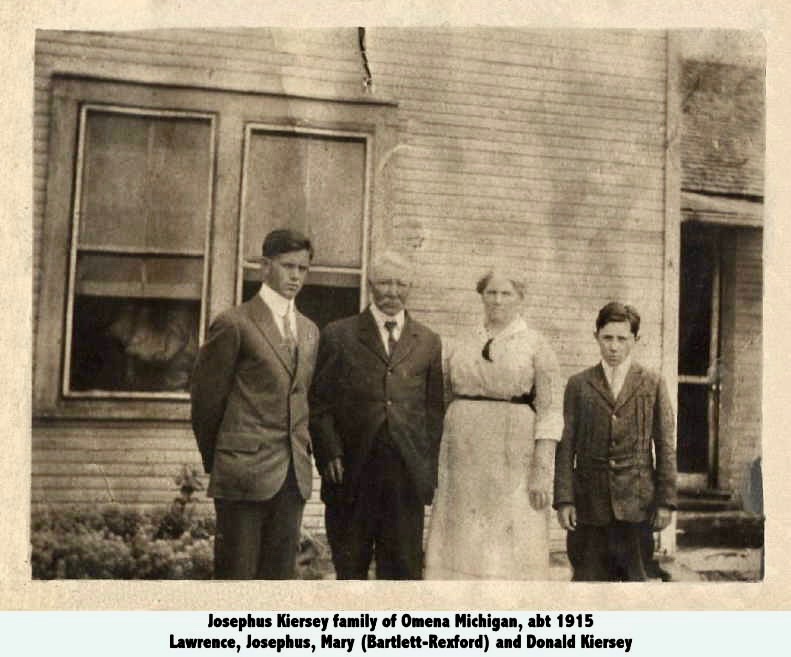
Josephus Kiersey, a charter member of Omena Congregational Church and the last funeral of the church, the bookends of this little church’s history. His wife, Mary, was also a long time member. With their two sons Lawrence and Donald. – Courtesy Katja Sage, Josephus’ great granddaughter
One Last Service at the Church
The church was reopened one more time for a funeral, that of Flavious Joephus Kiersey. He was Ole Kiersey’s grandfather, a charter member of the Congregational church. He had been faithful member for all the years of its existence. “Joe” died in 1932 after a long illness, a year after the church officially closed. Rev Badder came back to officiate.
The church stayed empty for years and years after that funeral. I remember walking through the dark and cobwebbed sanctuary about 1970 with the minister of the Congregational Church of Northport at the time. Somewhere along the line the steeple was removed. Then it was bought and remodeled by the Methodists. They used it for an assisted living home called Omena House. Later it was a retreat center where groups such as those studying painting under Edee Joppich met yearly along with other groups.
From Church to Vacation Rental
Today the church building is a 5,000 square foot vacation rental. It has two fireplaces and a private beach owned by Dale Monty and Elizabeth Tucker. It is listed as a “Spacious and Peaceful Retreat” with VRBO, It has 9 bedrooms sleeping 19-22 people, 3 half baths and 4 full bathrooms, has breathtaking views of the bay, and a steep price tag. $1,200 per night. The little church building now makes big money.