

Morgan Landing, the train station near Ahgosatown.
This photo is credited to Betty Craker Armstrong and is courtesy “Omena, A Place in Time” and the Omena Historical Society
Ann Morgan must have thought things could not get any worse. First Frankie, her 9-year-old son died, scarlet fever it was. Then word came that her husband Jesse was dead from a service-related illness, his body in Little Rock, Arkansas, impossibly far away in those days. She could not even bury him next to little Frankie in the Mission Church Cemetery

Rev. George N. Smith, the Indian Missionary and Congregational minister from Northport, who occasionally came to lead church services at the schoolhouse. Ann was the witness for a few weddings Rev Smith performed in her schoolhouse during this time.
Mission School Closed
But then due to circumstances beyond his control, Rev. Peter Dougherty was forced to close the Mission School in Omena where Ann was a teacher, and her other son Norman went to school….and where they lived. Ann and Norman were without a home or school.
But Ann was a tough one. She applied for another teaching job she had heard of in a small Indian settlement three miles southwest of Northport. Ann and Norman spoke the Indian language, Norman fluently. Ann got the job. Little did she know what she was getting into. To get to Onumnese where the school was, Ann and 7-year-old Norman had to troop through the forest with their belongings, with just an Indian trail to follow. It was a long walk, and when they finally trudged up the last hill and spotted the log school, there was no village and not even a little log house for them to live in.
The Indians were scattered in the forest, and the place she and Norman were to live was a few rooms attached to the back of the school, on a steep hill about 200 feet above the roar of waves on Lake Michigan. The wind whistled through the cracks between the logs.
The following Monday morning Ann opened school by ringing the bell. Only a few Indian children emerged from the woods, and they were not as good students as the Indian children Ann had been teaching at the Omena Mission School. She taught them slowly and patiently that first year, and more Indian children joined them as time went on until she had about 20 children of all ages in her class.

The porch of Omena Church in the summer of
1918. Left to right: Mr. Morgan, Rev. Reuben Hartley, Clara Pierson. Norman Morgan is the man facing the camera with his arms folded looking like he did not want to have his picture taken. Courtesy Omena Historical Society
Lonely Life in the settlement
But Ann was lonely seeing only the children every day. She had just one white neighbor, the Ranger farm which was about one and a half miles away and she sometimes saw people from this farm. Occasionally, Rev. George N. Smith, the Indian Missionary and Congregational minister from Northport, came to lead church services at the schoolhouse. Ann was the witness for a few weddings there during this time. But after one year, Ann wanted company. She invited her neighbor Ester Ranger, a single lady from the nearby farm, to come live with them. Although it was more crowded now, the sound of Ester weaving on her carpet loom throughout the following winter was comforting to both Ann and Norman during their second winter there.
At the end of the second year in Onumnese, Norman was almost ten years old and had not yet attended any school except his mother’s Indian one room schools. His friends were Indian children, and he spent much of his time speaking the Indian language. Ann knew that she had to move back to town for her son’s future. Ann was an accomplished seamstress, and the village of Northport was becoming a popular place to live. She decided to move there, enroll her son in the Northport school and try to make a go of sewing. New settlers were arriving every day and she had plenty of work. Life went on fairly easily for the next four years.
Ann Marries Robert Lee
Then in 1871 when Norman was 13, Ann’s life changed again. She met and married Robert Lee, a widower with three children. Robert was a successful businessman who owned the sawmill on the Mill Pond in Northport. Robert and Ann bought more property in Leelanau County, some of it actually was in Ann’s name (unusual at that time). They had two more children together, now there were six.
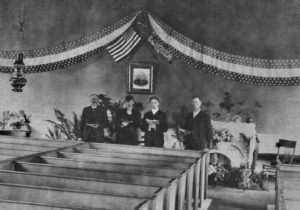
One of these men standing at the front of the Omena Church in 1918 is Norman Morgan. Can you guess which one? Courtesy Omena Historical Society.
Norman, who had grown up with Indians, still spoke the Indian language well and was a big asset to the grocery store where he started working when he was 17. When he turned 20, he married Abbie Voice and Ann sold him the property which was in her name in Northport. Norman and Abbie saved their money and when they had enough, he bought his own grocery store. He used his ability to talk with Indians in their own language to attract their business. He and Abbie adopted five children.
Norman Moves to Omena
Later Norman and his family moved to Omena to help with the Presbyterian Mission School and living near Ahgosatown. Norman was active in the Omena Church, helping with translating to the Indians in Sunday School. Details of Norman’s life are sketchy, but he was well liked enough to have the Ahgosatown train station named after him by 1905. He must have been good friends with Leonard Wheeler because when Leonard died in 1917, Norman was asked to bear the casket at the funeral along with other familiar names at that time: John Putnam, A. F. Anderson, Paul Barth, and two Indians David Ogemagegedo and Jacob Ahgosa. “All Indians feel they have lost their best friend and helper.” Wrote one of Leonard’s brothers. I am sure another good friend was right there beside them: Norman Morgan.
Read Ann’s story before this turning point in her life in a previous blog post titled Frankie Morgan.
Courtesy Omena Historical Society’s archives for sharing the writings of Elizabeth Craker Armstrong, and “Omena, A Place in Time” by Amanda J. Holmes