
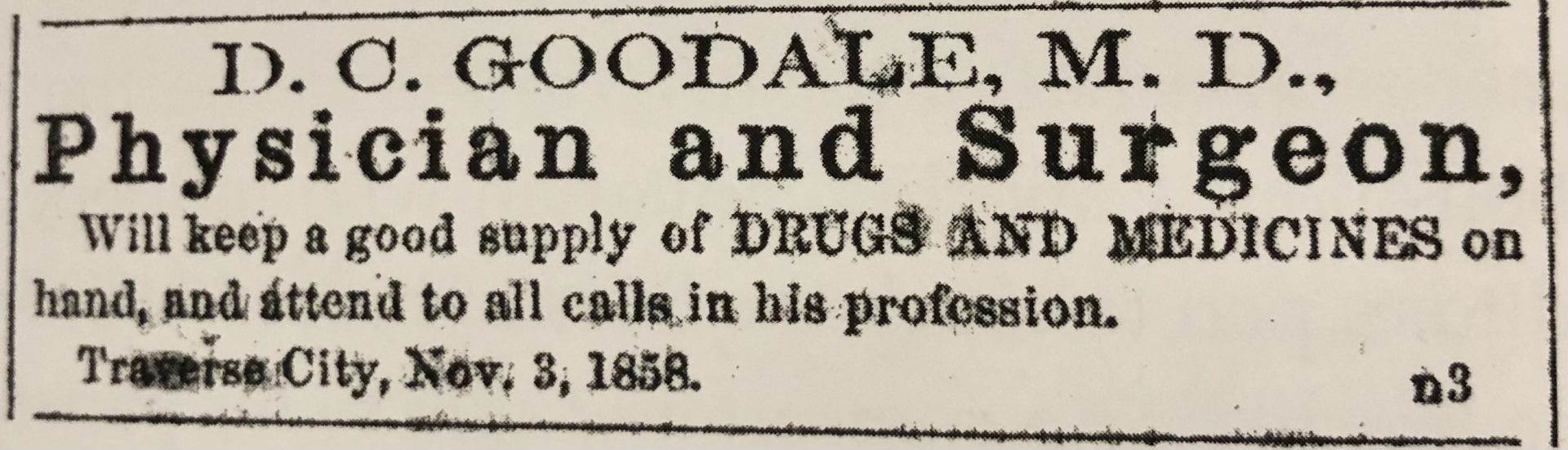
Dr David Goodale, MD, was brought to Traverse City in 1853 mainly to manage the large boarding house of Hannah and Lay, a large company needing housing for its employees.
He soon realized he was needed as a physician, being the only doctor in residence in the village. Courtesy Grand Traverse Legends, by Robert E Wilson
Sickness was unknown to most of us,” wrote Amalia Kropp in the Bohemian language used by the people of North Unity on the western side of Leelanau County in 1856. “There wasn’t any doctor here to begin with, but if anyone got sick, we used to call on Mrs. Musil. She was always ready to help with her home remedies. Especially her bass-wood tea, or horse radish plasters, and believe me, after those treatments you HAD to get up.” There were side effects…even then.
Medical Care in the Village of Northport
In the village of Northport, the only medical attention you could get at that time was from Reverend Smith who arrived in 1849. When Dr S. J. Hutchison arrived from the east in 1867, to become the first doctor in the area, you can bet Reverend Smith was glad to see him!

A 19th century doctor’s drug supply.
You can sense the anxiety here when he was called upon to minister to a woman having a difficult pregnancy. From Rev Smith’s diary: “Was called in the night again to see Mrs. Ribbel. Found her low and failing, examined, found no particular change. Flowing badly, bandaged her thighs, gave her LAUDAUM injections and continued the opium, added snow to the cold applications.”
Laudanum is a reddish brown, extremely bitter substance containing several opium alkaloids, including morphine and codeine. It was principally used as a pain medication and cough suppressant. “It was regarded as an all-purpose drug. One physician called it ‘God’s own medicine,'” said a medical historian at the University of Washington School of Medicine.
But a Swedish Study done in 2017 reported that mothers exposed to opium during pregnancy had a 74% higher risk of preterm delivery or miscarriage. Of course, Rev Smith did not know that. He was only trying to relieve Mrs. Ribbel’s pain.
From Rev. Smith’s diary the next day: “Mrs. Ribbel was delivered of a 5-month dead child about day light this morning without pain or any unfavorable circumstance. They are satisfied my corse (his spelling) has been correct. I called to see her 8am, her prospect of recovery is quite good though she has been brought very low.”
Mrs. Ribbel was one of the lucky ones. “Traditional medical practices during most of the 19th century relied on symptomatic treatment consisting primarily of bloodletting, blistering, and high doses of mineral poisons. These medical regimens resulted in high rates of death in patients unfortunate enough to undergo treatment.
Rev. Dougherty Provide Medical Care

Alcohol was often a key ingredient in early remedies.
Rev. Dougherty was also expected to provide medicine to the Indians from the beginning of his ministry in 1839. Rev Dougherty was employed by the Presbyterian board and supported by its missionary boards. He did receive an allowance from the government for medicines dispensed to the Indians. He also acted as a physician for his sick neighbors on Old Mission. The closest physician at the time was on Mackinac Island. His diary records the following bit of information: “May 14, 1850. After school bled a sick woman in the village. This evening prepared some medicine for Mrs. Cowles. May 16, 1850. Saw a sick woman and applied a blister to her chest.”
Providing care in Traverse City
Rev. Dougherty was called upon to act as doctor in what is now Traverse city as well. Mrs. Duncan, the keeper of a boarding house there, was very sick. Two or three days after Rev Dougherty first saw her, he had not heard from her. He became anxious about her and set out with a further supply of medicine for her. He started out for the head of the bay on foot, walking along the beach. There was no bridge over the Boardman River near the boarding house, and there being no time to lose. He quickly entered the stream and waded across, the cold water coming up to his chin. Fortunately he found his patient much improved; unfortunately, the boat in which he had hoped to return was already nearly out of sight on its way back to the peninsula.
He could have stayed the night, but felt he must return home. Not stopping to put on a dry suit that was offered him, he had a hasty lunch and set out on his return. Once he was out of sight in the woods, he took off his shirt and hung it on a stick he carried in is hand as he walked. The day was warm and soon it was nearly dry, so he exchanged it for his flannel (underwear?). He hung his flannel on the stick and carried it the rest of the way. It was nearly sundown when he got home, thoroughly fatigued, but happy his patient was getting well. The next day he was so sore and stiff he could scarcely move.
Herbal Medicine
The Old Mission manse of Peter Dougherty today has an extensive herbal garden. From his herb garden Dougherty could have treated many things, such as:

Bee Balm could be made into a medicinal hot tea. It has a long history of medicinal use for Native Americans as a strong antiseptic and poultice for skin infections and minor wounds. It was also used for stomach and bronchial ailments and mouth and throat infections as well as headaches and fever. – Photo courtesy of Marisa Fancy
A typical herbal remedy made from Bee Balm could be made into a medicinal hot tea. It has a long history of medicinal use for Native Americans as a strong antiseptic and poultice for skin infections and minor wounds. It was also used for stomach and bronchial ailments and mouth and throat infections as well as headaches and fever. “Surely Peter Dougherty had Bee Balm in his garden.
Another plant he must have used is Mullein, a tall, hairy, biennial plant that can grow up to 6 feet tall. “The leaves, flowers and roots were used by Native Americans to treat respiratory problems, coughs, congestion, asthma, bruises, tumors, rheumatic pain and hemorrhoids as well as teething. The Indians also used it as moccasin inserts to keep their feet warm.” Such a useful plant belonged in the gardens all residents of early Leelanau County!
Also Lambs Quarters for Gout, Colic, Insect stings and rheumatic pains. Evening Primrose for treating wounds and bruises, sore throats, and hemorrhoids; and Rose Hips for coughs and sore throats, fevers and indigestion. It even is helpful for your rheumatism.
There is something for everyone here!