
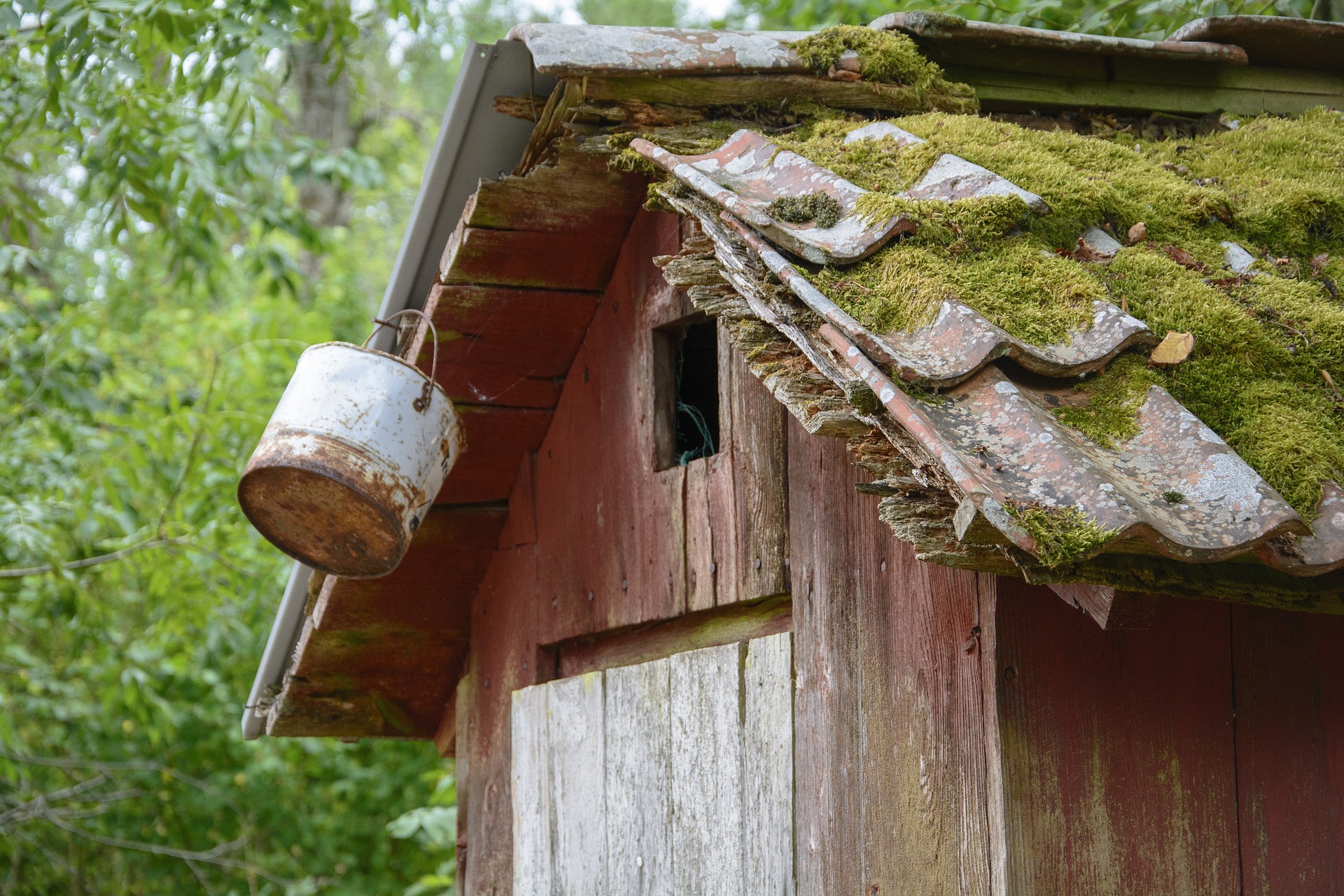
Once there were many little buildings out behind the cottages in Omena that the children used as secret hideaways. Some of them were used as tool sheds. Some just stood there in case they were needed again. These were once the outhouses of Omena Point.
Until the late 1920s all of the cottages had outhouses. Then gas powered pumps became available that could pump lake water to tanks in attics or raised tanks next to houses where gravity would take the cold water to faucets inside. Finally in 1932 electricity had reached Omena Point so water was readily available most of the time. Outhouses were a thing of the past.
Jonnie Hodgson’s family came to Omena in the early 1900s from Cincinnati where public water had been available since 1834. Arriving at the cottage, named “The Pioneer,” they knew what to expect. Like its name suggested, it was rustic, “about as rustic as you could get,” Jonnie said. Her father thought it was good for his children to learn to live like people used to live. They must have had an outhouse.
 But when Fred Gotham first arrived at their cottage, “Camp Lookout,” in the summer of 1921, and discovered the only toilet facility was an outhouse behind the cottage, he wondered what he had gotten his poor family into. The cottage did come with cold running water from a reserve tank at The Oaks hotel. It came through an above ground pipe that sometimes had good pressure, sometimes low pressure, and sometimes there was no water at all. After the first shock, however, Fred decided the view of the bay and the other pleasures of Omena made using an outhouse an “acceptable sacrifice.” And after a while he was able to install indoor plumbing and he “never had to be noble again.”
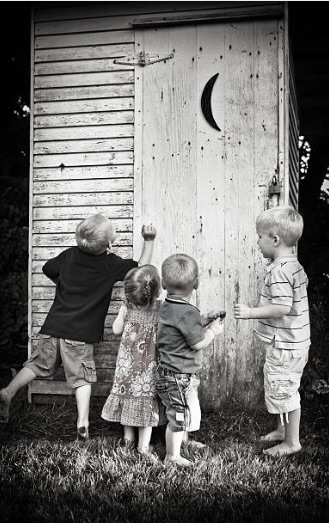
In John Fitzgerald’s children’s book, “The Great Brain,” Fitzgerald talks about the outhouses in the 1890s as being not only necessary, but as a sort of status symbol. The poorest families in town had a simple one-holed structure, those with a little more money had two-holers, but the mayor owned one with ornate woodwork and even heating. There are no photos of Omena’s outhouses, but I believe they were simple structures. Perhaps they had a star or a moon cutout in the door. It was common practice back in the day, for a moon cutout to mean it was a women-only outhouse…. the moon symbolizing the Roman goddess, Luna. The sun, representing the Greek god Apollo, meant it was a men’s outhouse. But probably if there was a sun or a moon in the door of Omena’s outhouses, it was for ventilation or decoration only.
Of course, that would let bugs and spiders in too as they loved to take up habitation in outhouses. I remember when I was little being scared by the spiders in the outhouse when I visited my grandpa at his cottage on Fish River in Alabama. Some people limited the bug population and controlled odor at the same time by using lime from a bucket of powdered lime just inside the outhouse door. After using the outhouse, you were expected to toss a scoop of lime into the hole. My grandfather did not want lime around where there were little kids, so he had a pail of it in back of the outhouse under a wooden flap that he lifted up before shoveling in lime from time to time. I loved grampa’s cottage, spiders, and all.
One cottage that did not have an outhouse was Janet and Bill Graf’s. Their cottage in 1926 had a pump on the back porch. It was Janet’s brother, Doug’s job to pump 100 strokes of the pump handle every morning to fill the storage tank for the day. The storage tank was in the attic or was an elevated tank outside which fed cold water into the faucets inside. There were no flush toilets. And there was no outhouse.
Instead, they had a little room off the back porch where they had a “portable John.” “It was a big can with a toilet seat on it.” Janet says. Every so often her brothers would stick a mop handle under the handle of the pail and carry it up into the woods for disposal. Poor brothers! No doubt they envied their neighbors with outhouses!
Courtesy “Omena, A Place in time” by Amanda Holmes, Omena Historical Society, and Wikipedia