
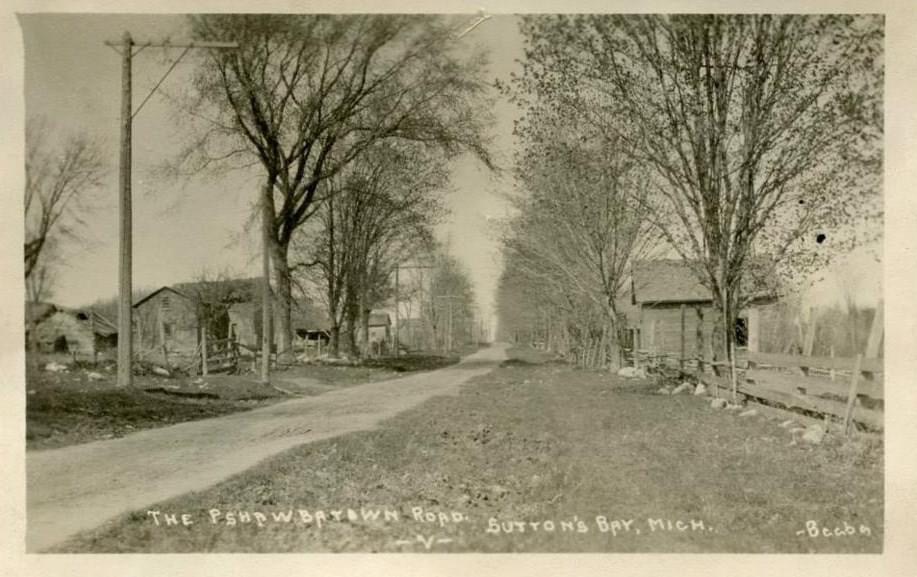
Early photo of the main road in Peshawbestown. There are many spellings of this little village. Courtesy Weengush Odeimin
“We have a terrible sickness here at this place,” wrote Francis Blackman of Peshawbestown. Writing to the Mackinac Office of Indian Affairs on November 9th, 1881, he went on to say, “most everybody is sick…except two little girls who cannot do much of anything. We need lots of help at this place.” Out of food, barely able to keep enough firewood on hands to keep warm, he was pleading for supplies, “flour, pork, cornmeal and tea.” Smallpox was killing them one by one.
Ruth Craker recalls in her book, “during the Mission days, a scourge of smallpox broke out among the Indians, which caused many deaths among them. Whole families were stricken, and the death rate was very high. Mrs. Dan Chippewa remembers being taken to the Dougherty’s Mission House as a child to avoid the disease if possible.”
It came in the fall of 1881, when two Native American men had helped to unload two schooners that docked in Traverse City. In the process, they contracted smallpox from one of the people on the boats and took the infection back to the Ottawa reservation in Peshawbestown. The infection spread and, in an effort to contain it, health officials quarantined the entire village and the residents were not able to buy food or get medical help.
Dr. Nelson Forbidden to visit Peshawbestown

Letter from Francis Blackman, Suttons Bay, Peshawbestown , to George Lee, of the Mackinac Office of Indian Affairs, Nov. 9, 1881. – Courtesy Ryan Johnson, David Ulrich & Tina Ulrich
St. Clair County Community College & Northwestern Michigan College
Dr Nelson from Northport did what he could for them, visiting all the houses in the village in which there was sickness. When he returned to his home in Northport however, he was told by the Board of Health he was forbidden to visit the Indians again for fear of spreading the disease to his other patients. He wrote a letter to the Mackinac Office of Indian Affairs that November saying “What shall I do?” The Indians have “requested me to come again to them with disinfectants and to vaccinate those who are still free of the disease, and they are not allowed to leave the place. I promised to do so and am awaiting some fresh vaccine from Detroit any day now.” “This action of the board stops me.”
So, they were prisoners in their village. Cut off also from the rest of the world. Even the mail carrier who passed through their village refused to carry a letter to the Office of Indian Affairs for them. They offered to pay him well to bring them supplies, which he also refused. “What are the poor Indians to do?” Dr Nelson asked.
Office of Indian Affairs
The Mackinac Office of Indian Affairs answered immediately by letter and telegram. Dr Nelson, after reading their instructions, “proceeded next morning in horse and buggy” to vaccinate and care for the sick people of the village. He was stopped two miles from the village by a man who said he was ordered to stop him if he attempted to go to Peshawbestown. The good doctor retorted that since he had not been “notified by the Board of Health of any obstruction to a physician attending his patients, I shall go where I pleased” and, as he reported to the Office of Indian Affairs, “I done so!”
Supplies Arrive
Meanwhile, help had arrived. Omena’s Mr. William Keyes had been hired by the Township to supply the Indians. He would call on them twice a day, supplying them with flour, crackers, corn meal, rice and tea. Setting up shop in the schoolhouse, William organized the distribution. Dr. Nelson spent an hour with him watching William weighing the supplies and entering that in a book with the name of the Indian who received it. He also, reports Dr Nelson, sleeps in the schoolhouse, which is centrally located. When any in their family are taken sick, they can go to the schoolhouse and get carbolic acid dissolved in water for them (which sounds terrible, but at the time, Dr Nelson believed be a good treatment).
“The Agosa family suffered very severely nearly to be exterminated,” Dr Nelson continued in his letter to the Office of Indian Affairs in Mackinac. “Mitchell Agosa died last night and also his father, mother, and grandchild. Two of his children a few days before. Joe Blackman’s family makes 5 deaths last evening. I think in all this 17 deaths, and during the week 3 more will go.”
Vaccinations Eliminate the Disease
By November 18th, Dr Nelson had vaccinated 32 Indians. He promised to vaccinate all of the Indians he could reach when he received more supply from the Mackinac Office. “I believe the disease is checked,” he wrote. “ And with the exception of the cases named, the greatest number will recover.” So the disease was eliminated with vaccination after just a few weeks.
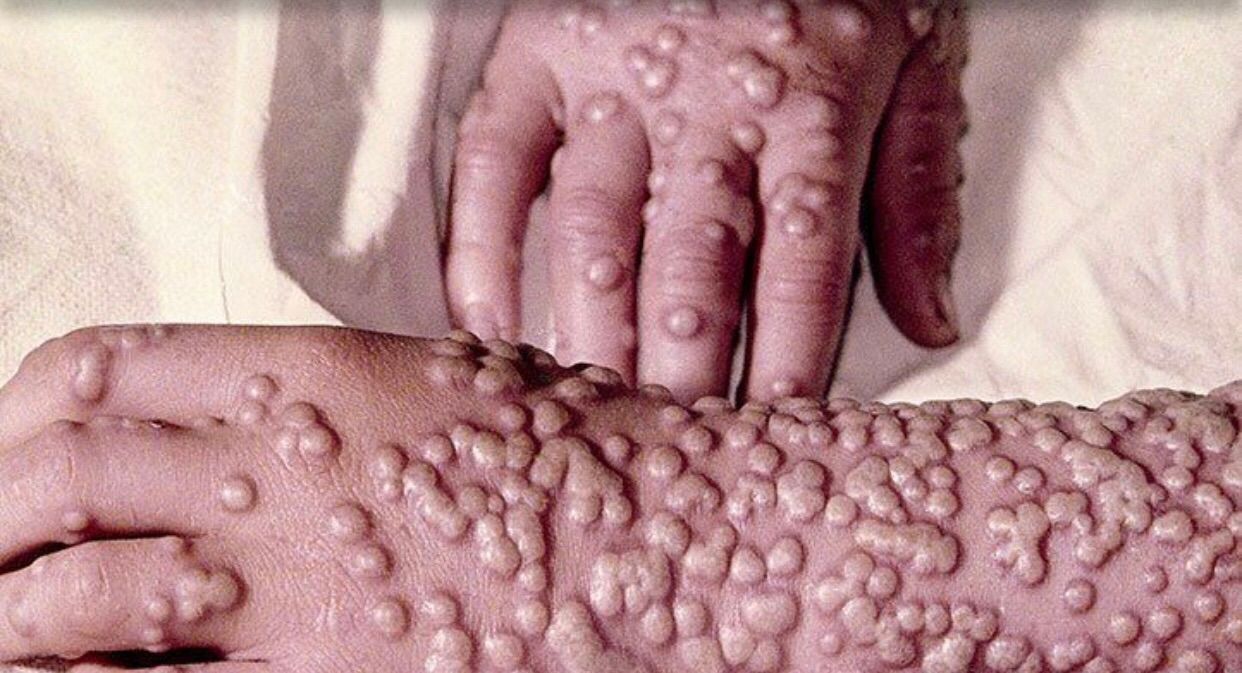
Smallpox is highly infectious, with a distinctive rash that changes in appearance as the disease progresses. – Courtesy Joseph Bennington-Castro, medically reviewed by Sanjay Sinha, MD in Everyday Health Newsletter November 17, 2021
“The exact burial place of all those who died of smallpox is unknown. Those in Peshawbestown were said to have been placed in a ‘fish house by the lake below the school’. The building was then burned.” As horrible as this sounds, perhaps the survivors of those terrible times of smallpox were comforted by their beliefs that burning the deceased helps them enter the afterlife. It was the custom of many tribes to burn the dead. They believed that the smoke sends the body upward in their journey. It was necessary to wipe out any disease contamination, but gave little chance for those remaining to mourn.
Fear of Disfigurement for Survivors
The Indians who survived were often horrified at the disfigurement caused by the disease. Some believed that any disfigurement of the body in life would be reproduced in the afterlife. A Mandan chief, Four Bears, declared, “I do not fear death, my friends…but to die with my face rotten, that even the wolves will shrink at horror at seeing me…”. Smallpox was certainly what he was referring to.
European diseases such as smallpox spread quickly through Indian communities in the early days. They had little natural immunity to them because they had no previous exposure to those diseases. Early responses they used to sickness such as sweat lodges made the sicknesses more deadly. Smallpox vaccine had been introduced by a British physician, Edward Jenner in 1796 and was something available to white settlers. After more contact with Europeans such as the missionaries and doctors in the area, vaccination and quarantine helped to prevent or slow the spread of smallpox among the Indians of the Leelanau in the coming days.
Courtesy Ryan Johnson, David Ulrich & Tina Ulrich, St. Clair County Community College & Northwestern Michigan College, “Heritage of Provident” by Vonda Belanger, Ruth Craker, “The First Protestant Mission in the Grand Traverse Region”, Culture and Death: Native American Heritage, “Native Americans and The Smallpox Epidemic”, “Native American Beliefs and Medical Treatments During the Smallpox Epidemics: an Evolution” by Melissa Sue Halverson, and Britannica