
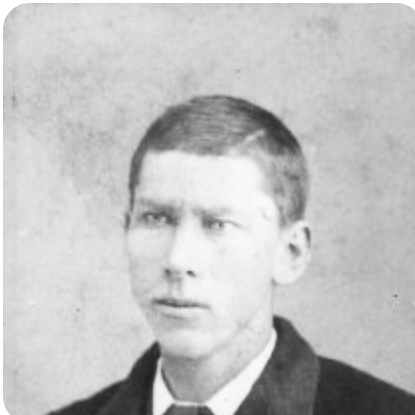
Charles Kehl was one of John and Elizabeth Kehl’s many (I think 9) children. These are the Kehls whose farm was at Kehl Lake. Interestingly his father, John Kehl was a shipbuilder who would leave the farm in the winter and go to Wisconsin to build ships. The W C Kimball was built in Wisconsin. Elizabeth, Charles’s mother, stayed in Northport at the farm with the kids while he was gone. There are still descendants living in Northport. – Courtesy Marsha Buehler
Charles Kehl was a young man just 27 years old who had just gotten married the previous fall, a newly-wed. There was a baby on the way. He had everything to live for. But he was a sailor.
“Forest fires had been breaking out all over the Grand Traverse region that unusually warm, dry spring of 1891. The air was filled with wood smoke, flying cinders, and burning leaves that fell for many hours.” writes Larry Wakefield. “At night, the sky was red with flames in every direction. In Traverse City fire came over the hill behind the asylum and burned 150 cords of wood and lots of fence posts. D.H. Day lost one million feet of hardwood logs at Glen Haven. Isolated barns, houses and small shops burned down all over the Grand Traverse and Leelanau counties. People prayed for rain.”
The disappearance of the W.C. Kimball
Out into the smog covered lake on May 8, 1891 went the W. C. Kimball, a little schooner sixty to seventy feet in length, with her crew of three. Capt. James Stevens and Mate Charles Kehl, part owners of the boat, as well as William P. Wolfe, were aboard, all members of prominent Northport families, as well as a passenger headed for Sutton’s Bay. Leaving Manistee, they were loaded, perhaps overloaded, with 200 barrels of salt and had 250,000 wooden shingles stacked on her deck.
After clearing the Manistee harbor, the Kimball sailed north for the Manitou Passage into oblivion, never to be seen again. The steamer Williams of Charlevoix was dispatched to search for survivors, but none was found and no bodies ever were recovered.
Was it run down by a larger schooner in the fog? Was the crew washed off during the storm. There wasn’t much freeboard and the side railing was not even knee-high. Was it swamped by the high waves of the northwest gale which was lashing the Great Lakes or was the water cold enough that it iced the boat, adding weight which caused it to sink? For 129 years where and why the Kimball went down has remained a mystery. To the families in our area, it must have been an agonizing time. Especially to Charles’ wife of just 6 months.
The Discovery of the Kimball
Then on Nov 16, 2019, the Chicago Tribune announced:

A shipwreck found almost by accident by Shipwreck hunter Ross Richardson, Technical Diver Steve Wimer and a group of other wreck enthusiasts, sitting 300 feet deep in northern Lake Michigan, is being described as one of the “most intact wooden schooners” in the world. – Courtesy mlive.com, Nov. 12, 2019
“Ross Richardson, shipwreck hunter, has made one of the most significant shipwreck discoveries ever in the Great Lakes … a little schooner nobody’s heard of. Why is it so significant? Because it’s the most intact 19th century wooden schooner shipwreck in the world. No other vessel of its type has been as well preserved.”
Despite its nearly pristine condition, there were no identifying marks on the schooner. After much investigation, it was found to be the Kimball. The question of where it went down was solved, but why it went down was even more of a puzzle. It was not run down by another larger ship or there would have been damage to the hull. That it was in perfect condition led the divers to believe it had been slowly covered in ice in the storm which added the weight which caused to to sink. This would have helped preserve it in perfect condition.
During the dive and ROV-led inspection, the team noticed the Kimball’s lifeboat was still attached to its stern which is very unusual considering the schooner sank within a few miles of multiple shores. This led them to believe it was possibly unreachable at the time the wooden schooner went down. Perhaps the ice covering the schooner made it impossible to reach the lifeboat.
The Lake Michigan waters are cold in May up in the Leelanau …but cold enough to sink a ship? We may never know.

The Kimball
The Kimball was built across the lake in Manitowoc, Wis. in 1888, was just three years old when she sailed out on her last voyage on the evening of Thursday, May 7, 1891
The official description of the WC Kimball:
Type at loss: scow-schooner, wood
Build info: 1888, Manitowoc, WI
Specs: 63x17x5
Date of loss: 1891, May 8
Place of loss: near Pt. Betsie, MI, Lake Michigan
Type of loss: Foundered
Loss of life: 4 [all] – including CPT James Stevens, Charles Kehl, Peter Carl Andreason and William P. Wolfe.
Carrying: shingles, salt
Detail: Outbound from Manistee for Sutton’s Bay, she foundered in a thick NW gale.
Sources: mv,h,nsp,nsp,hgl,sb,usls
Courtesy of Marsha Buehler and the Omena Historical Society, Larry Wakefield’s article at Michigan Mysteries, Find-a Grave information, Chicago Tribune November 16, 2019, mlive.com November 12, 2019, and Scuba News February 8, 2020 by Kathy Dowsett.