OVPA Blog

Halloween

Halloween Greetings

Photo Credit: Flickr. The pumpkins we carve today are descended from the Jack-O-Lanterns of the past, which were a blend of immigrant custom and Native American harvest crops, according to The Henry Ford Museum. Early Halloween parties were, back then, matchmaking parties for young people with games to “predict” marriage futures and much opportunity for flirtation. You can see that in this photo from the Henry Ford, and in this chapter of the book “Spells, Charms, and Incantations.” Happy Halloween everybody!  


Armed Robbery in Omena

Barth General Merchandise Store

It still happens at least once a summer, but in the early years of cars, the quiet of the night would often but broken by the screeching of tires, and a loud splash as an old car missed the corner of M-22 in Omena and splashed into Omena Bay. Speeding in Omena is not a new thing. Speeding through town, and the resulting consequences, has happened ever since the early 1900’s. It was against the law then and still is now. But this is Omena. Other crimes happened as well in this peaceful little hamlet. Saturday nights when the migrants… Read More »


Summers at the Manse

The Marbachs – Rob, Will, and Rev Marbach standing on M-22 in front of the parsonage. 1930’s. Courtesy Omena Historical Society. M22 was a busy road in 1928, but unpaved. The road grader went by twice each day, up the hill to Northport in the morning, and back south to Suttons Bay each afternoon smoothing out the ruts. It raised a lot of dust, but that did not bother Bob and Effie Barth, or their cows who crossed the road twice each day to get to pasture and back. And it did not bother Bill and Rob, two little boys… Read More »


Janet Barth

The little house Janet lived in for most of her life is across from Omena's historic Presbyterian Church. Kathy and Mike Bosco now own it and are preserving it from future development. Photo credit: Omena Historical Society archives

The little house Janet lived in for most of her life is across from Omena’s historic Presbyterian Church. Kathy and Mike Bosco now own it and are preserving it from future development. Photo credit: Omena Historical Society archives. “Mr. Bushman” often made the Omena Column of the Leelanau Enterprise in the 1980’s. Who was this Mr. Bushman? We had a homeless man who had come to the village to work at the cherry processing plant during the cherry harvest for a few years. He probably worked nights and usually spent his days sleeping under a bush near the Omena Public… Read More »


General and Mrs. Byron Cutcheon

This is the waterfront near where General Cutcheon and his wife had their cottage, Maplewood, from 1896 to 1908. He once said that he wanted his town’s future to remain “as evergreen as our forests, and as everlasting as the inland sea.” The first day of autumn is only a couple of days away. You can feel it in the air. You can hear it in the waves and the wind. In September of 1903, Mrs. Byron Cutcheon wrote to her friend Rebecca Richmond from their cottage on Omena Point. She reported that, “The general is feeling the drafts.”  She… Read More »


Clara Pierson, Author

Clair Pierson Children's Author at her desk

Clara at her desk in “Pencroft”, her cottage in Omena. Courtesy OHS Archives. The heat was suffocating the summer of 1896 in Traverse City. It was a long-delayed vacation in which the young couple had hoped to get away from the heat, but it appeared it had followed them. By lucky coincidence, they happened to meet an old friend in their Traverse City hotel, who recommended they take a steamer north to Omena to escape the heat. Clara Pierson and her husband, John, took the suggestion, and after their stay at the Omena Inn, they were so taken with Omena… Read More »


Preserving Fruit

Preserves

Preserved Fruit – Photo Credit: Don Lee Aldrich. I remember my mother and grandmother sitting at the kitchen table talking loudly over the radio as they peeled peaches for canning. No doubt my grandmother did the same with her mother before that. I think about them as I peel apples for applesauce. Without preserving fruit back then, you had a pretty fruitless winter. The farmhouses in this area mostly had root cellars or Michigan Basements where they stored their canned fruit, potatoes, apples, and other things. They had simple dirt floors and fieldstone walls which held the frost at bay… Read More »


Omena Presbyterian Church

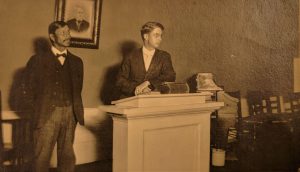
Jacob Ahgosa, Elder and grandson of the first Chief Ahgosa, and Reverend Plymate deliver the service one Sunday morning. Usually, the townspeople sat on the east side and the Native Americans, and a few local residents sat on the west side so Jacob Ahgosa could translate the service for the Indians assembled.

Jacob Ahgosa, Elder and grandson of the first Chief Ahgosa, and Reverend Plymate deliver the service one Sunday morning. Usually, the townspeople sat on the east side and the Native Americans, and a few local residents sat on the west side so Jacob Ahgosa could translate the service for the Native Americans assembled. Thanksgiving is a time to be grateful for our Native American neighbors who have shared our long history in this wonderful place. In 1867 the Presbyterian board of Foreign Missions ceased its financial support for the Omena church, Rev. Dougherty sold the mission buildings, retired from the… Read More »


Pirates in Leelanau County

The Wanderer

The Wanderer. The battered 40′-50′ two masted schooner with dark sails Seavey acquired in the early 1900’s. Credit: laststandzombieisland.com. Once there were Pirates in our area according to many sources. I just finished reading Sprague’s History of Grand Traverse and Leelanau counties, a large and old book (1903). Here is how they described these freshwater pirates in the flowery language of 1903. “Boats named “Nighthawk, Dark-cloud, Fly-By-Night, or Dread-Naught came swooping down on the unsuspecting settlers with their tan colored sails shielding them from observation at night.” “Wing-in wing they came tearing down into the bay, sailing forth in their swift winged… Read More »


Logging in Northern Michigan

Lumberjacks

Here one of the lumberjacks is doing card tricks for the others. People thought the trees in northern Michigan would last for many years, but within a 20-year period, 1870 to 1890, most of the trees were cut. Logging was a dangerous and risky winter job. Lumbermen were often injured or killed. The men worked from 4am to dusk, even eating their noon meal in the cold winter woods. The logger’s meals were plentiful, if boring. Infectious diseases like chicken pox were a problem with the crowded conditions in the bunkhouse. The men were in the woods many months with… Read More »